
A college budget works best as two layers: a semester layer for the big lumps (tuition, housing, meal plan, books) and a monthly layer for food, transport, and social spending between aid disbursements. For 2025-26 the College Board put published tuition and fees at $11,950 in-state public, $31,880 out-of-state, and $45,000 private nonprofit, with housing and food adding $13,900 to $15,920. Label every loan row honestly as income that has to be repaid, and the sheet becomes a plan instead of a wish list.
Most college budget templates fail the same way: they treat the whole year as one flat list. Tuition lands in August, gets paid, then nothing happens in that row for 4 months. Meanwhile the food and transport rows churn every week. The work below covers what to put in each layer, how loans fit alongside aid and earnings, and which line items families and students leave out the first time around.
The college budget is two budgets
The semester layer holds the big, lumpy spend: tuition and fees, housing, meal plan, books, lab and course fees, dorm or apartment setup at move-in. These show up two or three times a year and stay flat in between.
The monthly layer holds the cash flow: food outside the meal plan, transportation, personal care, phone, internet (off-campus), entertainment, social spending, and the small recurring stuff that adds up. This is where the money feels like it is leaking.
Two layers, one workbook. A “semester” tab with rows for each lump and columns for fall, spring, and summer. A “monthly” tab with rows for each cash-flow category and columns for each month of the academic year. A small dashboard tab that sums both into a semester or annual total. One flat tab forces a choice between two cadences and ends up serving neither.
2025-26 cost baseline from the College Board
The starting point for any budget is what a typical institution charges before aid. The College Board’s Trends in College Pricing 2025 puts the published figures at:
| Sector | Tuition and fees | Housing and food | Estimated total budget |
|---|---|---|---|
| Public 4-year, in-state | $11,950 | $13,900 | $30,990 |
| Public 4-year, out-of-state | $31,880 | $13,900 | $50,920 |
| Private nonprofit 4-year | $45,000 | $15,920 | $65,470 |
| Public 2-year, in-district | $4,150 | (varies, often commuter) | $21,320 |
Published prices are the sticker. After grant aid, the College Board’s estimate of average net tuition and fees was about $2,300 for in-state public 4-year and about $16,910 for private nonprofit 4-year in 2025-26. State, family income, and individual award offers push that around a lot. Holding both sticker and net side by side in the sheet keeps visible what is owed and what is being covered before loans fill the rest.
The semester layer in detail
Six categories cover most of the semester spend.
- Tuition and fees. The university’s billed amount. Lands in the sheet in the month it is due, not averaged out.
- Housing. On-campus dorm fee per semester, or rent if off-campus. Off-campus adds a deposit row in junior or senior year, often two months of rent up front.
- Meal plan or food allowance. On-campus students typically buy a per-semester plan ($2,500 to $4,500 is a common range at 4-year schools). Off-campus students convert this into a monthly grocery budget.
- Books, course materials, and lab fees. Textbooks vary widely by major. STEM and pre-med run heavier; humanities run lighter. Renting and digital editions can cut the total 40 to 70 percent versus new from the bookstore.
- Technology. Laptop replacement is irregular. The first year typically includes a laptop in the $750 to $1,400 range; year two through four often include software, accessories, and a phone replacement somewhere along the way.
- Move-in or dorm setup. Bedding, storage, lamp, fan, small fridge, the box of basics. Freshman year runs $200 to $800; sophomore year drops sharply unless moving to a first apartment, where furniture and kitchen setup spike.
The back-to-school budget template covered the start-of-semester surge in detail. That piece handles the few-week buying window; the semester layer here holds the whole-term picture around it.
A small worked example for an in-state public 4-year freshman, fall 2026:
| Semester line | Amount |
|---|---|
| Tuition and fees | $6,000 |
| Housing (dorm) | $5,200 |
| Meal plan | $2,800 |
| Books and course materials | $450 |
| Lab and activity fees | $200 |
| Technology (laptop year) | $1,100 |
| Move-in / dorm setup | $620 |
| Fall semester total | $16,370 |
Spring usually drops the laptop and dorm-setup lines and lands closer to $14,500. The laptop line then disappears for two or three years, books drift up modestly, and housing climbs each renewal.
The monthly layer in detail
Five rows handle most monthly cash flow. Students who want a planned-versus-actual view of these categories can drop them into Monthly Budgeting instead of a plain list. It runs one month at a time, with a budget figure set per category and an actual figure that fills in from the transaction log.
- Food outside the meal plan. Coffee, weekend takeout, late-night food, grocery runs. $80 to $200 a month is a common range even with a full meal plan.
- Transportation. Bus pass or parking permit, gas if there is a car, occasional rideshares, flights home for break. Off-campus students often pay $50 to $150 a month for transit; flights home add $200 to $600 a trip.
- Personal care and household. Toiletries, laundry quarters or cards, basic replenishment. $25 to $60 a month for most students.
- Phone and internet. Phone if on the family plan, often $0 to the student. Off-campus internet runs $50 to $80 a month split among roommates.
- Social and discretionary. Concerts, club nights, gifts, hobbies, the things college is partly for. Usually the most variable row. $50 to $300 a month, with peaks around holidays and birthdays.
A row at the bottom for “savings or buffer” gives the leftover a place to land instead of being absorbed into discretionary by default. Even $20 to $50 a month softens the months where one category blows out.
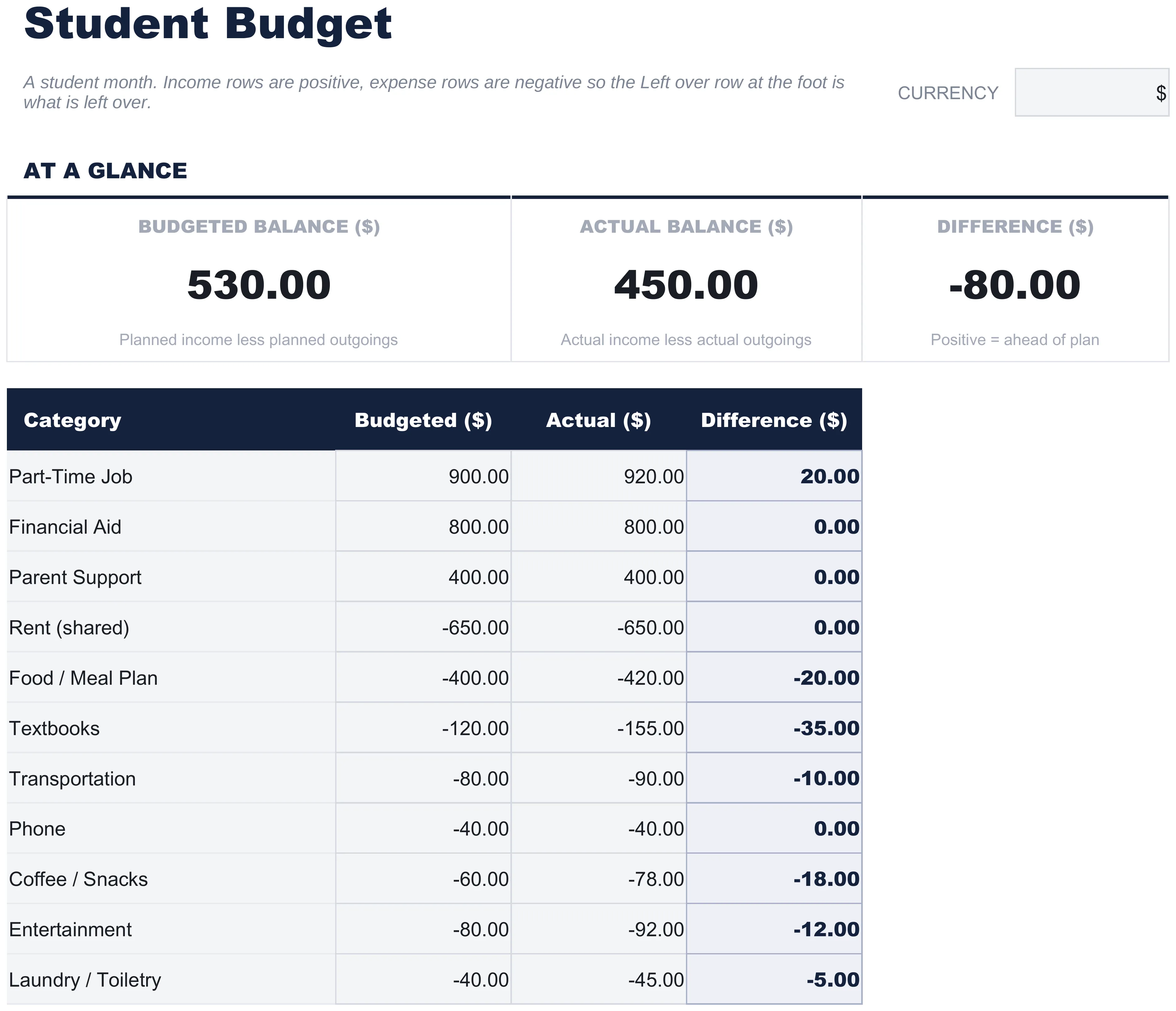
The free Student Budget template is exactly this monthly layer: income rows on top, expense rows below, budgeted against actual, netting to a Left over figure at the foot. FinancialAha, Free tier.
Income sources
A college budget has more income sources than most adult budgets, and that is what makes it confusing. One row per source, never netted into a single “aid” line, is what keeps the total readable.
- Family contribution. What parents are paying directly. Better as its own income row than netted against tuition, so the student sees the actual amount their family is covering.
- Grants and scholarships. Pell Grants, state grants, institutional scholarships, outside scholarships. Not repaid. Lands at the start of each semester from the financial aid office.
- Work-study earnings. Paid through the school for an approved job. Counts as income, gets paid biweekly or monthly, and shows up on the federal aid award letter as an amount the student can earn (not money already in hand).
- Outside job earnings. A part-time job not through work-study. Often steadier than work-study, which caps at the awarded amount.
- Loans (federal subsidized, federal unsubsidized, private). Income that has to be repaid, with interest. More below.
- Savings drawdown. Money from a 529, custodial UTMA, or family savings earmarked for college. A separate row prevents double-counting.
A summer-job earner heading into freshman year already has the income-side framework. The summer job budget template walks through paycheck withholding and the save / spend / share split that produces the starting balance going into fall.
Loans: income that has to be repaid
A federal subsidized or unsubsidized loan is income to the student’s account today, whether it pays tuition or shows up as a refund check, but it is borrowed at interest and the principal has to be repaid. Framing it as “free money this year” understates the cost; framing it as “future regret” makes planning harder. A separate row labeled “Loans (to be repaid)” with a notes column for type and rate is the honest middle.
For 2025-26 federal loan limits, a dependent undergraduate can borrow up to $5,500 freshman year, $6,500 sophomore year, and $7,500 junior and senior year (subsidized portions of $3,500, $4,500, and $5,500 respectively). The lifetime aggregate cap for dependent undergraduates is $31,000.
An extra column labeled “estimated monthly repayment at graduation” turns the abstract loan dollar into a concrete future payment. Rough math: $20,000 of federal loans at roughly 6 percent on a standard 10-year repayment runs around $220 a month for 120 months. Rates, terms, and consolidation choices vary, but seeing the future number next to the present-day disbursement changes how the decision feels.
Major matters here. Our student loan burden by major analysis covers debt-to-earnings ratios across 188 college majors. The headline finding: starting salary is the dominant driver of how heavy a given loan load lands, not the loan amount itself. The borrowing calculus looks different depending on what is being studied.
Hidden costs that get forgotten in year one
Six lines tend to be missing from the first attempt at a college budget. Adding them up front prevents the “where did this come from” moment in October.
- Health insurance. Many universities charge a mandatory health fee or insurance plan ($1,500 to $3,500 per year) unless the student is on a parent plan and waives. The waiver paperwork has a deadline.
- Travel home. Flights for Thanksgiving, winter break, spring break, and summer move-out. Out-of-state students can run $1,000 to $2,500 over the year. Booking windows matter.
- Off-campus utility deposits. Junior-year apartment move-in often requires deposits for electric, gas, internet, and sometimes water - $200 to $500 up front, refundable but cash-tied for a year.
- Course materials beyond textbooks. Engineering supplies, art studio fees, lab coats, specialized software licenses. Often $50 to $400 per term outside the bookstore line.
- Study abroad. A semester abroad can cost more or less than a home semester depending on the program. Budgeting the differential in junior year, when it is on the table, avoids a scramble later.
- Senior-year job-search costs. Interview travel, professional clothing, certification or test prep fees, a small gap-month buffer between graduation and first paycheck. $300 to $1,500 in the spring of senior year for students searching during school.
Year-over-year tracking across four years
A four-column “year” view next to the per-semester rows surfaces patterns no single year can. Three tend to show up:
- Books drop after freshman year. First-year general-ed sections often carry the most required new textbooks. By junior year, major-specific classes settle into recurring titles and rentals.
- Housing rises. On-campus contracts usually go up 3 to 5 percent a year, and off-campus moves in year two or three add the deposit hit once.
- The “small stuff” line stops being small. Discretionary, eating out, and rideshares often double between fall freshman year and spring senior year, even when income stays flat. Seeing the trajectory makes it a choice rather than a surprise.
A year-over-year table at the bottom of the workbook, pulling annual totals from each year’s tab, takes about 10 minutes to set up and pays off the first time a tuition increase letter shows up.
The parent / student shared structure
Two structures work, and the choice depends less on the spreadsheet than on the family.
- Single shared workbook. Parents and student both have edit access. Parents track the institutional payments (tuition, housing, meal plan); the student tracks the personal cash-flow rows. A monthly call walks through it together. Highest visibility; works when communication is already comfortable.
- Two linked workbooks. Parents keep an institutional-cost workbook for the year. The student keeps their own monthly budget. Quarterly, the two compare totals. Lower-friction; works when neither side wants day-to-day transaction visibility.
What matters more than the structure is the conversation: who is paying what, what happens if the gap is bigger than expected, and what the loan decision looks like in that case. The spreadsheet is the artifact; the conversation is the work.
Get the template
Four starting points, depending on where the student or family is in the process.
- Student Budget (free) - A single-month student budget. Income rows for a part-time job, financial aid, and parent support net against expense rows for rent, food and meal plan, textbooks, transport, phone, and a savings line, ending in a Left over figure. The monthly layer of this article, at no cost.
- Student Budget Essentials ($19) - The paid upgrade. A Budget Tracker sheet whose semester setup takes tuition out of the aid disbursement and divides what is left across the months in the term, plus a Dashboard with monthly and semester totals, a bar chart comparing budget against actual by category, and a pie chart of where the spending went. Closest fit for “I am planning a semester.”
- Monthly Budgeting - For the monthly cash-flow layer once a semester is underway. One month at a time, with budget and actual columns across 17 expense categories including Food, Transportation and Entertainment, and a Need or Want tag on each. Useful for students who want category targets for the month and parents tracking a per-month contribution.
- Monthly Expense Tracker - The simplest setup. If the goal is just to see where money is going for the first time, this is the lighter starting point. Track first, plan next semester.
The two Student Budget tiers work in Microsoft Excel and Google Sheets. Monthly Budgeting and the Monthly Expense Tracker are Google Sheets templates. None of them link to a bank account, and the paid templates are one-time purchases.
Related
- Back-to-School Budget Template (K-12 + College) for 2026
- Summer Job Budget Template for Teens (First-Paycheck Setup)
- Student Loan Burden by Major - debt-to-earnings ratios for 188 college majors
Frequently asked questions
What is the average cost of college in 2026?
For 2025-26, the College Board put average published tuition and fees at $11,950 in-state public, $31,880 out-of-state public, and $45,000 private nonprofit. Housing and food add roughly $13,900 to $15,920. Total budgets average about $30,990 in-state public and $65,470 private nonprofit. Wide variance by school.
Should I budget by semester or by month?
Both. Tuition, room and board, and books are semester lumps. Food, transportation, and social spending are monthly. A two-layer budget handles both cadences without confusion.
What gets forgotten in college budgets?
Health insurance gaps when moving off parents' plan, lab fees and course materials beyond textbooks, off-campus apartment utility deposits in junior year, study-abroad costs, and the senior-year job-search costs (interview travel, professional clothing).
Should parents and students share this spreadsheet?
Shared Google Sheets work well for parent-funded portions. Some families split: parents track the institutional costs, the student tracks personal spending. The honest conversation about who pays what matters more than the structure.
Is there a free student budget template?
Yes. FinancialAha's free Student Budget is a single-month sheet with income rows (part-time job, financial aid, parent support) netted against expense rows (rent, food and meal plan, textbooks, transport, phone, and a savings line), ending in a Left over figure. The Essentials version ($19) adds a summary dashboard and is built with semester-based finances in mind. Both work in Excel and Google Sheets.
How do I handle aid that lands as one lump sum in a monthly sheet?
One approach is to record the disbursement in the month it arrives and carry the balance forward, rather than dividing it evenly. That keeps the sheet honest about the low-cash weeks late in a semester, when the start-of-term aid has been drawn down but the next disbursement has not landed.
Sources
- Trends in College Pricing 2025 - College Board
- Subsidized and Unsubsidized Loans - Federal Student Aid, U.S. Department of Education
About this article
Tuition, fees, housing, and net-price figures checked against the College Board's Trends in College Pricing 2025 report for the 2025-26 academic year. Federal loan limits and the standard-repayment example checked against Federal Student Aid (studentaid.gov). Template sheets, inputs and outputs checked on 2026-09-10 against the shipped free Student Budget workbook, the Student Budget Essentials workbook (Dashboard, Budget Tracker) and the Monthly Budgeting Google Sheet (Summary, Budget Plan, Transactions). Last reviewed September 2026.