
The math behind financial independence - the 25x rule, three levers that accelerate progress, FIRE variations, and how partial milestones change your options along the way.
Financial freedom, also called financial independence, means having enough assets and income from those assets to cover living expenses without needing to work for a paycheck. It does not mean never working again. It means work becomes optional rather than mandatory.
The concept goes by several names: financial independence, FIRE (Financial Independence, Retire Early), or simply having “enough.” The math behind it is surprisingly straightforward.
Calculate your number: The FIRE Calculator sizes the target from your annual expenses and the withdrawal rate you set, then projects the years to get there at your expected return. For global context, see how FIRE numbers compare across countries in the FIRE Number by Country data analysis.
The Math
The core formula: take annual expenses and multiply by 25. That gives the portfolio size needed to sustain those expenses indefinitely using a 4% annual withdrawal rate.
| Annual Expenses | FIRE Number (25x) | Monthly Withdrawal at 4% |
|---|---|---|
| $30,000 | $750,000 | $2,500 |
| $50,000 | $1,250,000 | $4,167 |
| $75,000 | $1,875,000 | $6,250 |
| $100,000 | $2,500,000 | $8,333 |
The 25x multiplier comes from the “4% rule”, research by William Bengen (1994) [1] showing that a 4% withdrawal rate, adjusted for inflation, survived every 30-year period in US market history. The Trinity Study [2] later confirmed these findings across different asset allocations. It is a planning framework, not a guarantee.
Three Levers
Financial freedom accelerates through three mechanisms - and tracking all three is where the leverage shows up.
Expenses: Not about deprivation. Tracking spending reveals where money goes - and some of those outflows produce less satisfaction than others. The gap between “spending on what matters” and “spending on autopilot” is often larger than expected. The Monthly Expense Tracker makes this visible.
Income: Tom Corley’s five-year study on wealthy individuals [3] found that multiple income streams were a common pattern, spanning earned income, business, interest, dividends, rental, capital gains, and royalties. Diversified income provides resilience.
Savings growth: Early on, contributions matter more than returns. On a $10,000 portfolio, even a strong 10% return adds $1,000. But $500/month in contributions adds $6,000. Over time, the balance shifts, and once a portfolio reaches six figures, compound growth starts doing the heavy lifting. The Savings Calculator models this crossover.
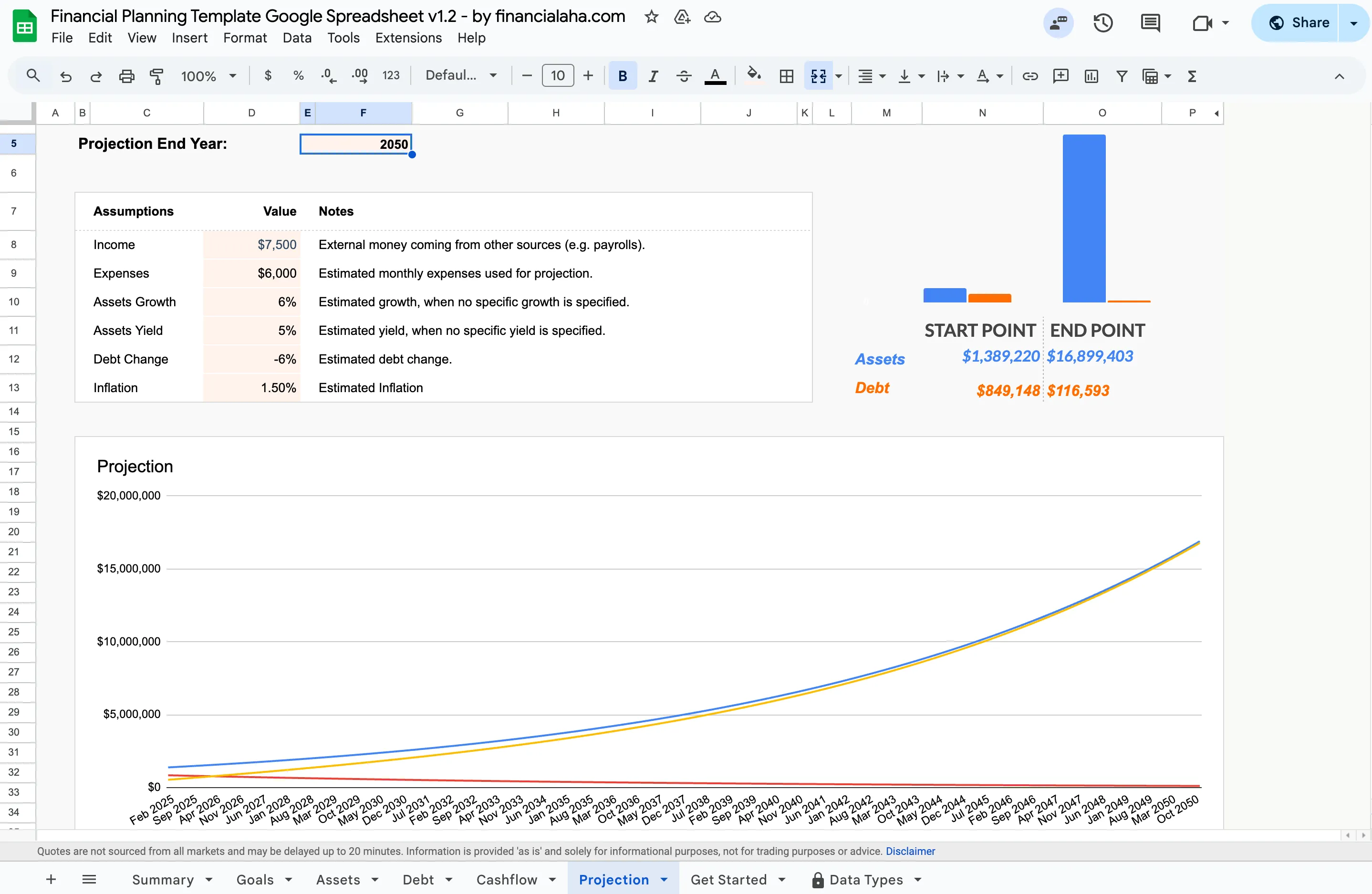
The Projection tab of the Financial Planning Template (Premium tier) projects assets and debt from today’s totals out to an end year you set, using assumptions for income, expenses, asset growth, asset yield, debt change and inflation.
Progress Shows Up Before the Finish Line
Financial freedom is a spectrum, not a binary state. Even partial progress changes things:
- 3 months of expenses saved - the ability to handle an emergency without debt
- 6 months saved - the ability to leave a bad job without panic
- 1-2 years saved - career decisions driven by preference rather than necessity
- 10+ years saved - work becomes genuinely optional
The Financial Runway Calculator shows how long current savings would last without income - a useful way to see where things stand at any point in the journey.
FIRE Variations
| Variation | Description | Target |
|---|---|---|
| Lean FIRE | Minimal expenses, frugal lifestyle | 25x lean budget |
| Regular FIRE | Comfortable middle-class expenses | 25x standard budget |
| Fat FIRE | Premium lifestyle maintained | 25x high budget |
| Coast FIRE | Enough invested that growth alone covers retirement | Stop contributing, let compounding work |
| Barista FIRE | Part-time work covers expenses, investments grow untouched | Lower target + small income |
More detail on each: FIRE Calculator: How to Calculate Your Financial Independence Number
Sources
- William Bengen - Determining Withdrawal Rates Using Historical Data (1994)
- Trinity Study - Retirement Savings: Choosing a Withdrawal Rate That Is Sustainable (1998)
- Tom Corley - Rich Habits Study: Background and Methodology
Related
- FIRE Calculator - Calculate your FIRE number
- Coast FIRE Calculator - When compound growth covers the rest
- FIRE Number by Country - Global comparison of FIRE targets
- FIRE & Financial Freedom Calculator - Detailed spreadsheet with projections
- Prepare for Retirement: Your Guide to Financial Freedom - Turning the FIRE math into an expenses, income, and gap plan
- Financial Planning Template - Track progress toward financial independence
Frequently asked questions
Does the 4% rule still hold up in 2026?
The 4% figure comes from historical US market data covering 30-year retirements. It is a planning framework rather than a guarantee, and some researchers now model a lower starting rate to allow for longer horizons or weaker return assumptions. Worth knowing that the FIRE Calculator lets you test a different withdrawal rate and see how the target shifts.
Does the 25x number include Social Security or a pension?
The 25x rule sizes a portfolio to cover expenses entirely from withdrawals. If a pension or Social Security will cover part of your spending, only the remaining gap needs to be funded by the portfolio, so the number you actually need can be smaller. Useful to model both the gross expenses and the portion covered by other income.
What withdrawal rate makes sense for a retirement longer than 30 years?
Bengen's original work tested 30-year periods. A retirement that starts early can run 40 to 50 years, and over a longer horizon a portfolio has more chances to hit a bad sequence of returns, which is why some early retirees plan around a rate below 4%. One approach is to run the number at several rates and compare the targets.
How is Coast FIRE different from Barista FIRE?
Coast FIRE means enough is already invested that compound growth alone will reach the retirement target, so new contributions can stop even while working. Barista FIRE means part-time or lower-stress work covers current expenses while the existing investments keep growing untouched. Both reduce the pressure to keep saving at full pace, but only Coast FIRE assumes contributions end entirely.
Sources
- Determining Withdrawal Rates Using Historical Data (1994) - Financial Planning Association / Journal of Financial Planning
- Retirement Savings: Choosing a Withdrawal Rate That Is Sustainable (Trinity Study, 1998) - American Association of Individual Investors
- Rich Habits Study: Background and Methodology - Rich Habits Institute (Tom Corley)
About this article
FIRE-number figures in the table apply a 25x multiplier (a 4% annual withdrawal rate) to each annual-expense amount. The 4% rule and 25x multiplier are checked against William Bengen's 1994 Journal of Financial Planning paper and the 1998 Trinity Study. Financial Planning Template claims checked on 2026-09-10 against the shipped Financial Planning Google Sheet (Summary, Goals, Assets, Debt, Cashflow, Projection, Get Started, Data Types tabs) and the Projection tab screenshot. Last reviewed September 2026.