Canada
Annual Tax Planner for Canada
Organize your Canadian tax picture, covering employment income, RRSP deductions, provincial taxes, credits, and deductions, in a Google Sheets template you own.
In Depth
Federal, Provincial, and the Tax Planning Window
Canadian tax planning is shaped by a layered system that most other countries do not share in quite the same way. Federal and provincial taxes are calculated separately, each with their own brackets, credits, and deductions. The combined marginal rate, which reaches roughly 54% in several provinces at higher income levels, is what makes the value of every deduction worth understanding clearly.
The RRSP contribution window is one of the most consequential features of Canadian tax planning. Contributions made before the early-March deadline reduce the previous year's taxable income, and at higher marginal rates the resulting refund can be substantial. Some people use that refund to fund the current year's TFSA contribution, creating a cycle where one account effectively helps fund the other. Tracking contributions against available room throughout the year prevents last-minute scrambles or accidental over-contributions.
For self-employed Canadians, the tax picture is more complex. Both the employee and employer portions of CPP fall on you, GST/HST collection and remittance may apply, and eligible business expenses need to be tracked carefully. The June 15 filing deadline for self-employed individuals provides extra time, but any balance owing is still due April 30. Having a year-round record of income and deductions makes tax season considerably less stressful.
Charitable donations deserve particular attention in Canadian tax planning. For 2026 the federal credit rises from 14% on the first $200 to 29% above that, and to 33% where the donation is matched against income taxed in the top bracket. Provincial credits add to this, and donation receipts can be combined between spouses. These credits are non-refundable, so they reduce tax owed rather than generating a refund on their own, which still leaves meaningful savings for regular donors.
Canada
Tax Planning in Canada: Key Considerations
Canada's combined federal and provincial tax system has a lot of moving parts. Knowing the main deductions and credits makes it easier to see what applies to your situation.
Federal and provincial taxes combine for significant rates
Federal rates run from 14% to 33% for the 2026 tax year, with provincial rates stacked on top. The combined top marginal rate varies from roughly 44% in Nunavut to around 54% in Nova Scotia and several other provinces. The federal basic personal amount, $16,452 for 2026 and phased down to $14,829 at the highest incomes, provides a tax-free base. Knowing your combined marginal rate is what makes the value of a deduction concrete.
RRSP contributions are the primary tax reduction tool
RRSP contributions directly reduce taxable income. At a 40% combined marginal rate, a $10,000 RRSP contribution cuts tax by $4,000. The deadline falls 60 days after year-end, which is March 1 or March 2 depending on the calendar. Tracking contributions through the year shows how much room is left before the annual cap, $33,810 for 2026.
Canadian tax credits reduce the tax bill
Federal and provincial tax credits for medical expenses, charitable donations, tuition and disability reduce taxes owed. The charitable donation credit is notably generous: for 2026 the federal rate is 14% on the first $200 and 29% above that, rising to 33% on donations matched against income taxed in the top bracket. Tracking eligible expenses through the year is what captures them at filing time.
Self-employment and rental income require careful tracking
Self-employed Canadians can deduct business expenses (home office, vehicle, supplies, professional development) against income. Rental property owners deduct mortgage interest, property tax, repairs, and other expenses. Both situations benefit from organized year-round tracking rather than scrambling at tax time.
Get the Template
Getting Started
Making the Tax Planner Work for Canadian Taxes
Enter all income sources
List T4 employment income, T4A contract income, T3/T5 investment income, rental income, and any other sources. Use gross figures - these are what CRA sees on your tax return.
Track deductions as they occur
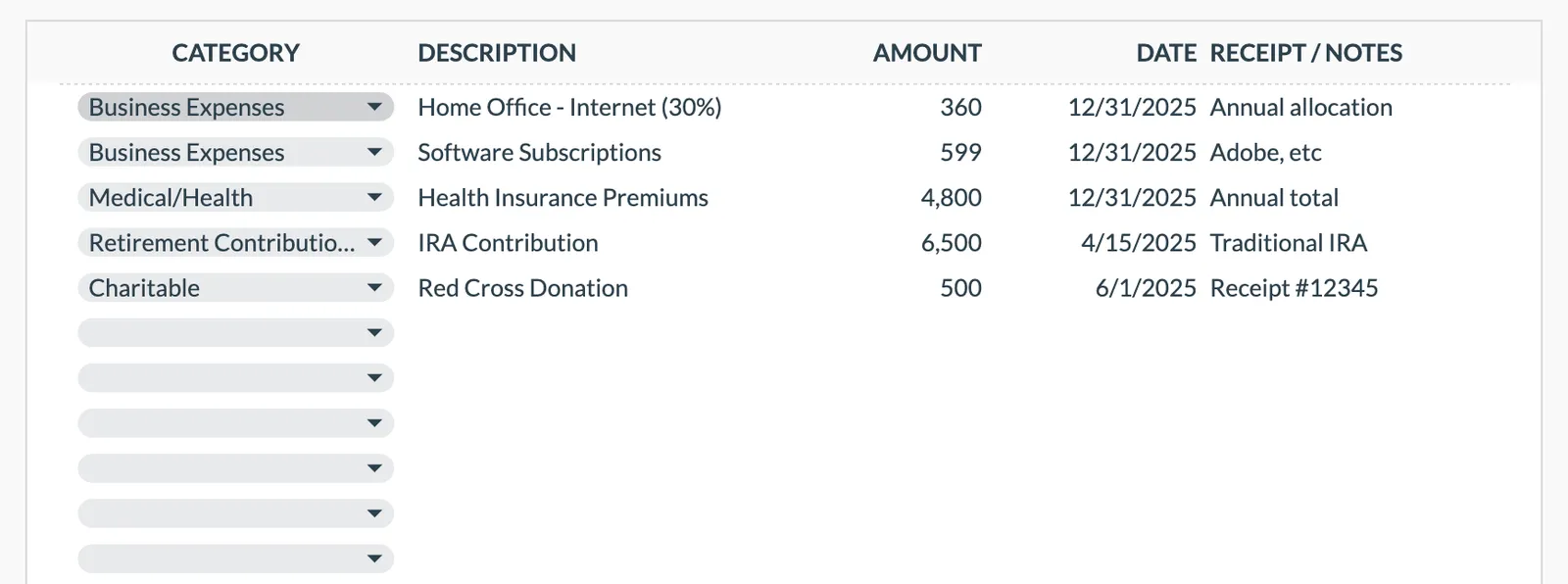
Log RRSP contributions, childcare expenses, moving expenses if you moved for work, union dues, and other deductions throughout the year. Having these ready by tax time removes the annual hunt for receipts.
Record eligible credit amounts
Track medical expenses, which count above the lesser of 3% of net income or the fixed annual threshold the CRA sets, along with charitable donations, tuition amounts, and other credit-eligible expenses. These convert to tax savings on your return.
Monitor your RRSP room
Your Notice of Assessment shows available RRSP room. Track contributions throughout the year to stay within the limit. Over-contributions beyond the $2,000 buffer are penalized at 1% per month.
Plan for tax instalments if applicable
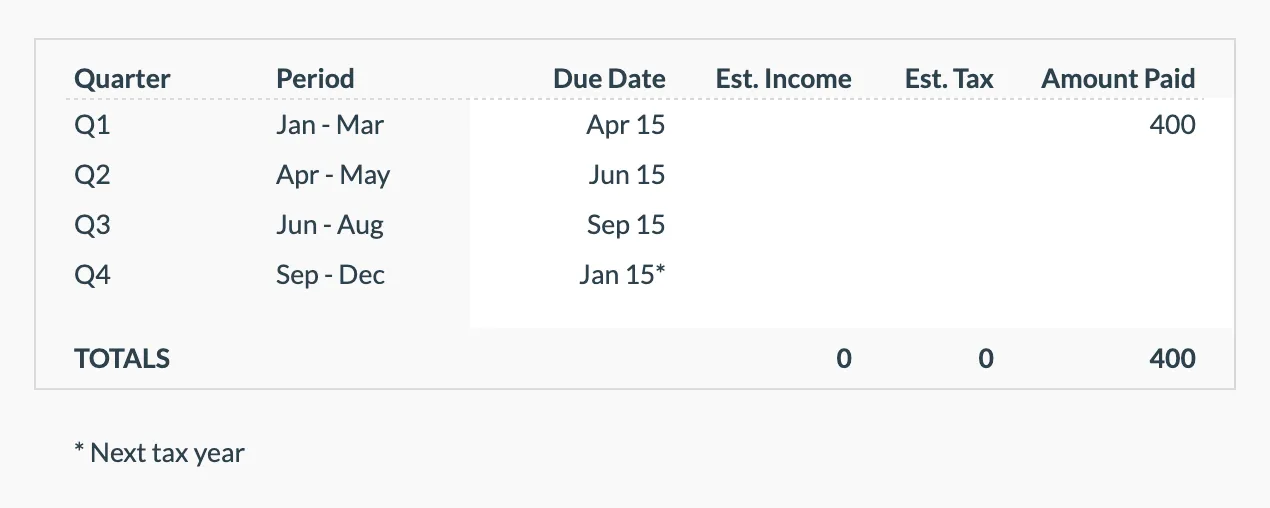
If you owe more than $3,000 in net taxes (or $1,800 in Quebec), CRA may require quarterly instalments. Track these payments to ensure they're made on time and accurately reflect your expected tax bill.
See It In Action
What the template looks like
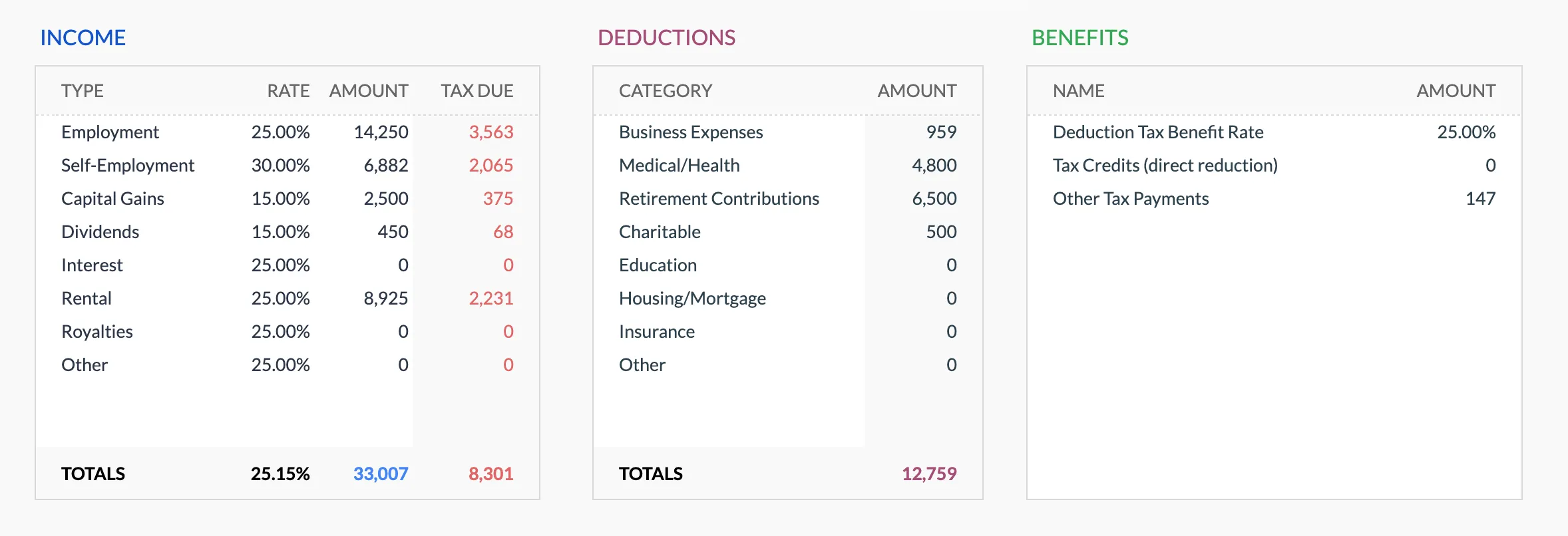
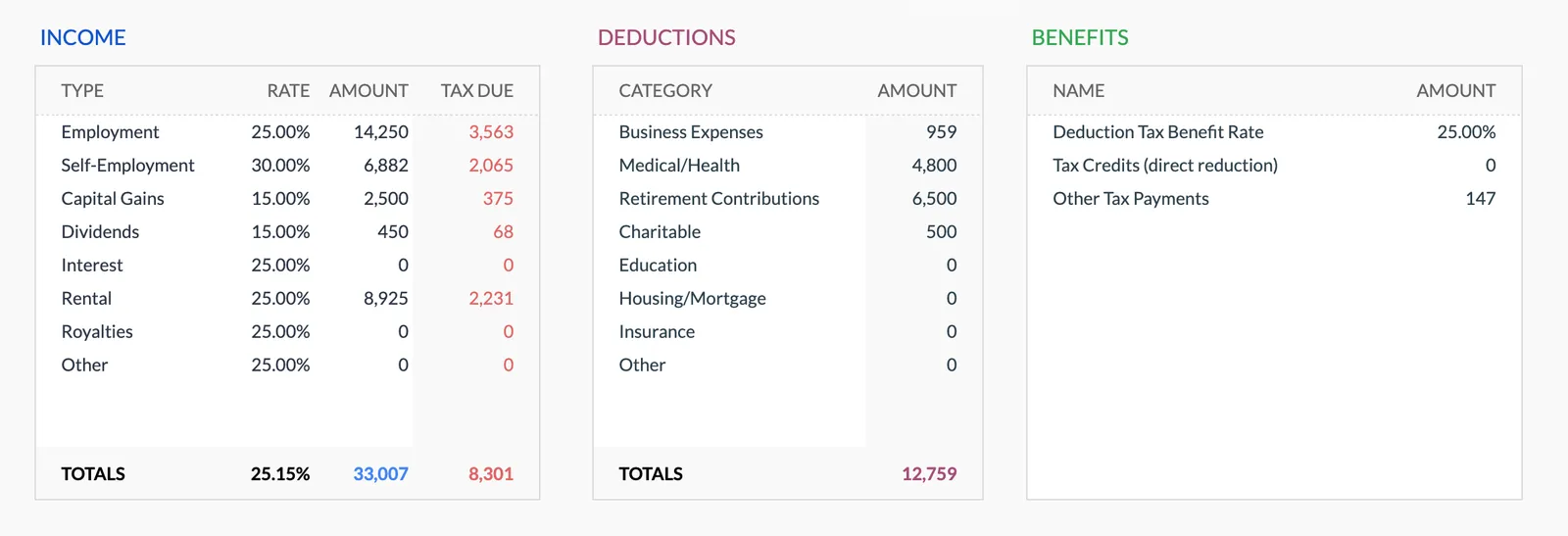
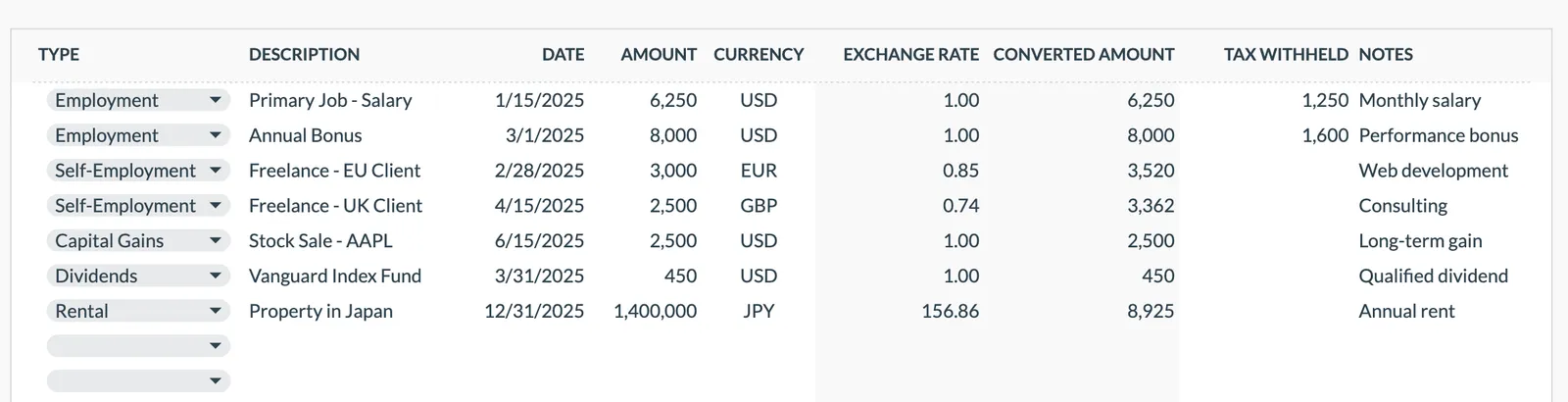
Browse through the template to see the dashboard, the entry sheets, and the summaries it produces, all adaptable to your local financial setup.
- Built-in currency selector
- Calculations update automatically
- Visual summaries of your numbers
- No setup required
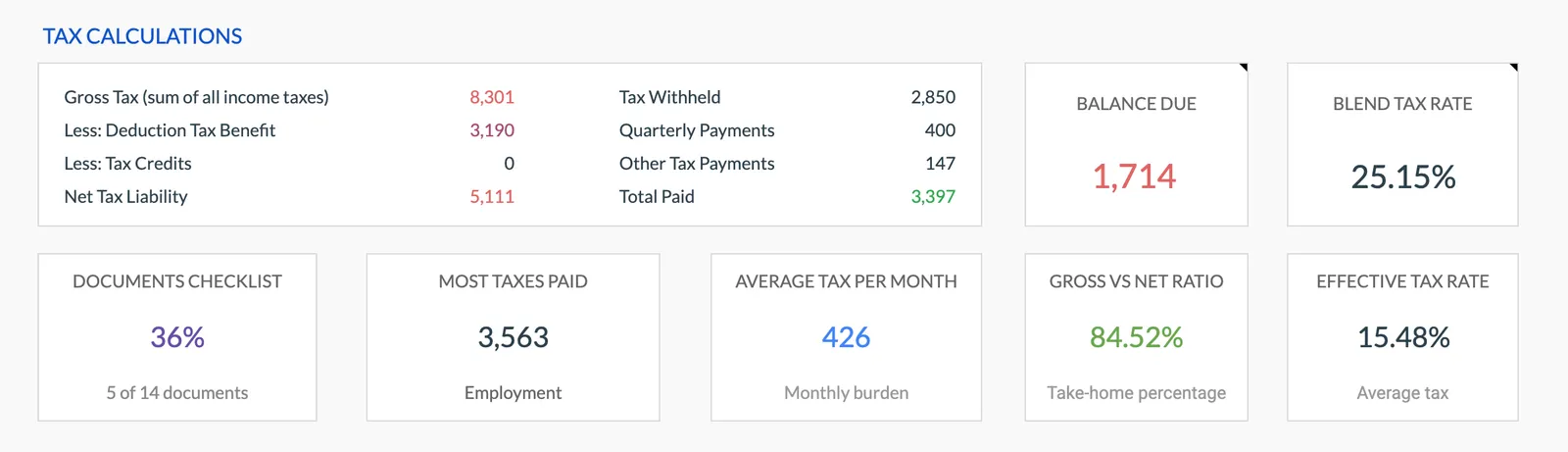
Annual tax overview with key figures
Detailed tax breakdown and projections
Track all income sources for tax purposes
Organize and track tax deductions
Plan and track quarterly estimated tax payments
Common Questions
Annual Tax Planner for Canada - FAQ
Can I file my Canadian taxes with this template?
No. This template organizes your tax-related information throughout the year. You still need to file through certified tax software (like Wealthsimple Tax, TurboTax, or StudioTax) or an accountant. The value is in having everything prepared and organized when filing time comes.
Does it calculate federal and provincial taxes?
The template organizes income and deductions but doesn't calculate the final tax bill. For estimates, use the free income tax calculator on this site or CRA's online tools.
How do I track TFSA for tax purposes?
TFSA contributions aren't tax-deductible and withdrawals aren't taxable, so they don't directly affect your tax return. However, tracking TFSA contribution room in the template prevents over-contributions, which are penalized at 1% per month.
Can I track provincial and federal separately?
Yes. You can create separate sections for federal and provincial deductions and credits. Some credits differ between federal and provincial levels. The template is flexible enough to accommodate whatever structure works for your province.
When is the Canadian tax deadline?
The general deadline is April 30. Self-employed individuals have until June 15 to file, though any balance owing is still due April 30. The RRSP contribution deadline for the prior tax year is typically March 1. The template can include these key dates as reminders.
Can't find the answer you're looking for? Contact our team
Explore More
Free Tools for Canada
Ready to get started?
Download instantly and start managing your finances, or contact us to design a custom template package for your needs.
Tax rules, rates, and contribution limits change, and official publications can themselves lag behind the law in force. We review these figures on a best-effort basis against sources we consider authoritative, but we cannot guarantee they are current, complete, or that better sources do not exist, and nothing here is tax, legal, or financial advice. For decisions, the relevant government authority is the reference.