Georgia
Tax Planner Template for Georgia
Organize your federal and Georgia state tax planning in Google Sheets. Track income, deductions, and credits with automatic calculations.
In Depth
Georgia's Flat Tax, Now in Place
Georgia finished transitioning its tax structure in tax year 2024, when a single flat rate replaced the old graduated brackets. That top bracket had kicked in at a relatively low income threshold, which meant most working adults in Georgia were already paying close to the top rate anyway. The rate has fallen each year since, reaching 4.99% for the 2026 tax year, with further reductions tied to state revenue targets.
For residents 62 and older, Georgia offers a retirement income exclusion of up to $35,000 per person, rising to $65,000 per person from age 65. It applies to pensions, annuities, interest, and dividends combined rather than each source individually, while Social Security is exempt on its own. Understanding how these income types aggregate against the exclusion cap is useful for projecting state tax liability in retirement.
Property taxes in Georgia vary widely by county. Metro Atlanta counties like Fulton, DeKalb, and Gwinnett have different assessment ratios and mill rates. The homestead exemption reduces the assessed value of a primary residence, which directly lowers property tax. For federal purposes, these property taxes plus any state income tax count toward the SALT deduction cap.
Georgia
Tax Planning in Georgia
Georgia has a flat income tax that applies to all taxable income, and the rate has been stepping down each year since tax year 2024. Atlanta-area residents may also need to consider local tax implications.
Flat Income Tax
Georgia replaced its graduated brackets with a single flat rate starting in tax year 2024. The rate is 4.99% for the 2026 tax year, down from 5.19% in 2025, with further reductions tied to state revenue targets.
Standard Deduction
Georgia offers a standard deduction for both single and joint filers. These amounts are independent of the federal standard deduction.
Retirement Income
Georgia provides a retirement income exclusion per person for taxpayers 62 and older, up to $35,000 at ages 62 to 64 and $65,000 from age 65. Social Security benefits are exempt separately and do not use up the exclusion.
Property Tax
Georgia property taxes vary by county. The homestead exemption can reduce property tax for primary residences.
Get the Annual Tax Planner
Getting Started
Getting Started with Georgia Tax Planning
Enter income and compare federal vs. Georgia deductions
Add all income sources to the template. Then note that Georgia's standard deduction, $24,000 joint and $12,000 single, is lower than the federal amount, so your state taxable income will likely be higher. Georgia generally requires the same standard or itemized choice made on the federal return, so the two returns move together on that point.
Calculate the retirement income exclusion if eligible
For residents 62 and older, track your combined pension, annuity, interest, and dividend income against Georgia's retirement exclusion limit of $35,000, rising to $65,000 from age 65. The exclusion is per person, so couples can each claim it, and Social Security is exempt separately. Use the notes section to record how much retirement income falls within the exclusion and how much is subject to the 4.99% rate.
Track county-specific property tax for SALT purposes
Georgia's property tax varies widely by county - Fulton County operates differently from Cherokee or Henry County. Enter your actual property tax in the deductions section to see how it combines with state income tax against the federal SALT cap. The homestead exemption reduces your assessed value, so use the post-exemption property tax figure.
Record estimated payments at both levels
If you have income not subject to withholding, Georgia requires estimated payments alongside federal ones. The flat rate makes Georgia estimates straightforward - apply the 4.99% rate for the 2026 tax year [1] to your projected state taxable income, divide by four, and track each payment in the quarterly tracker.
See It In Action
What the tax planner looks like
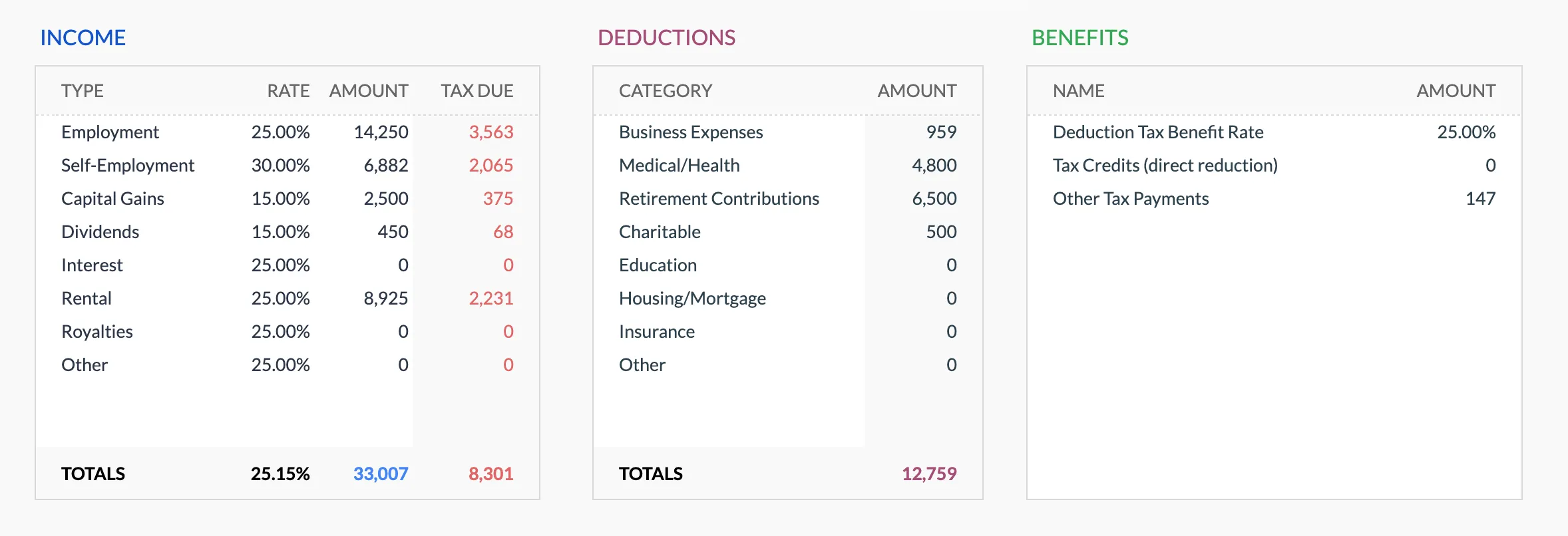
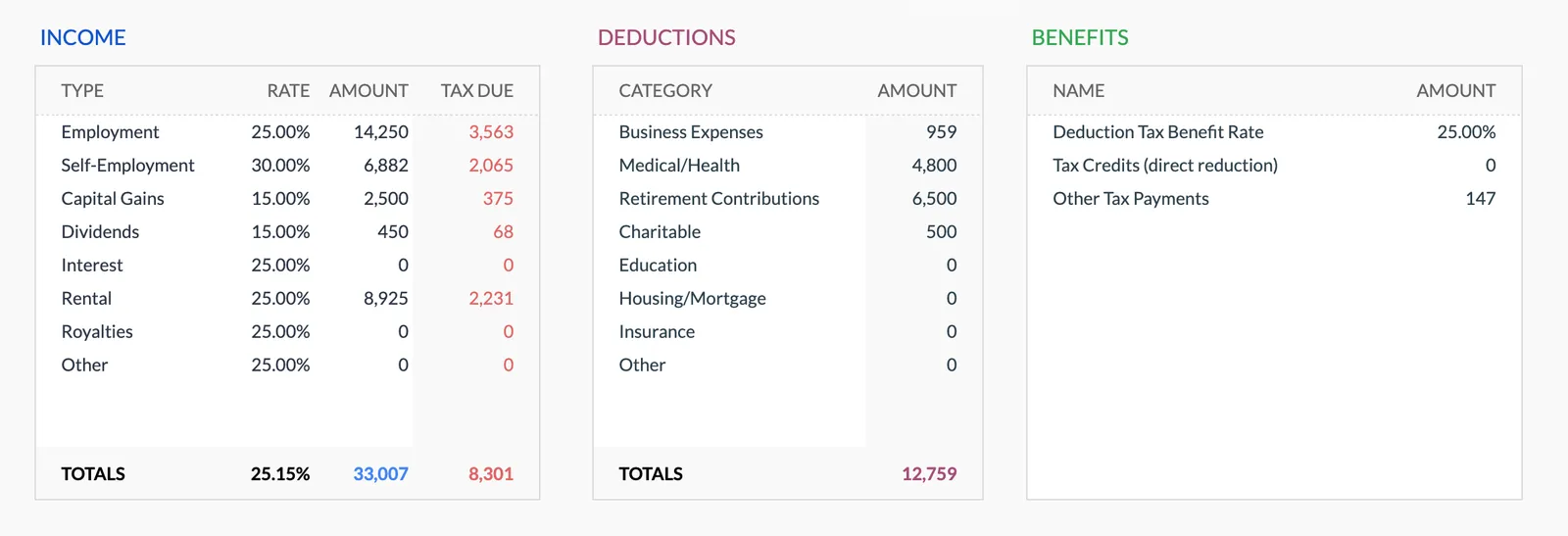
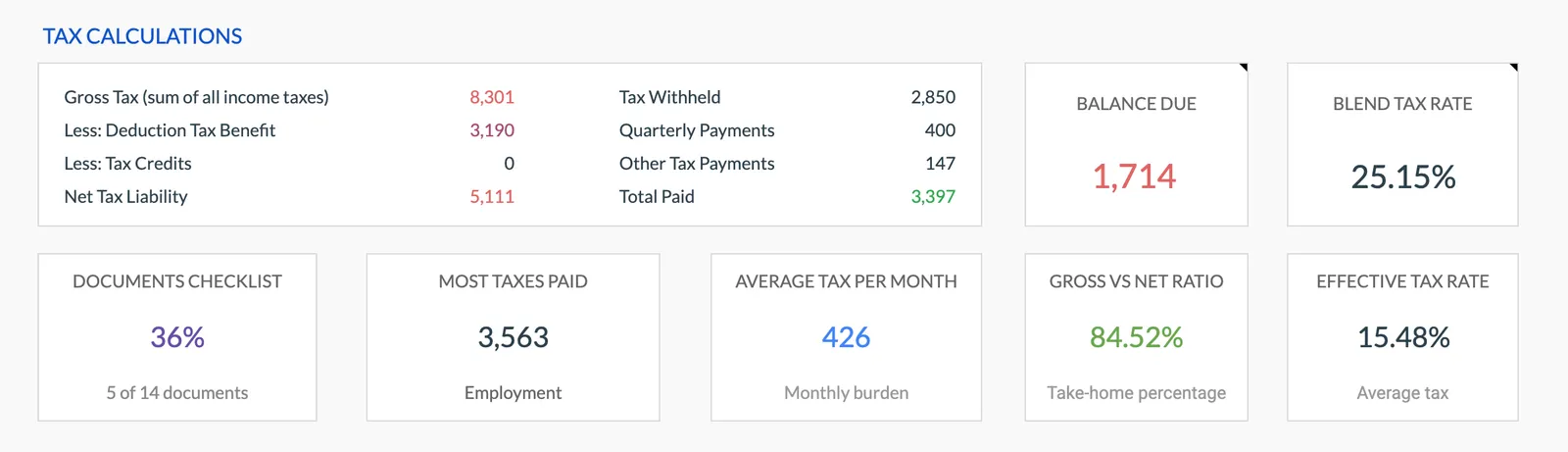
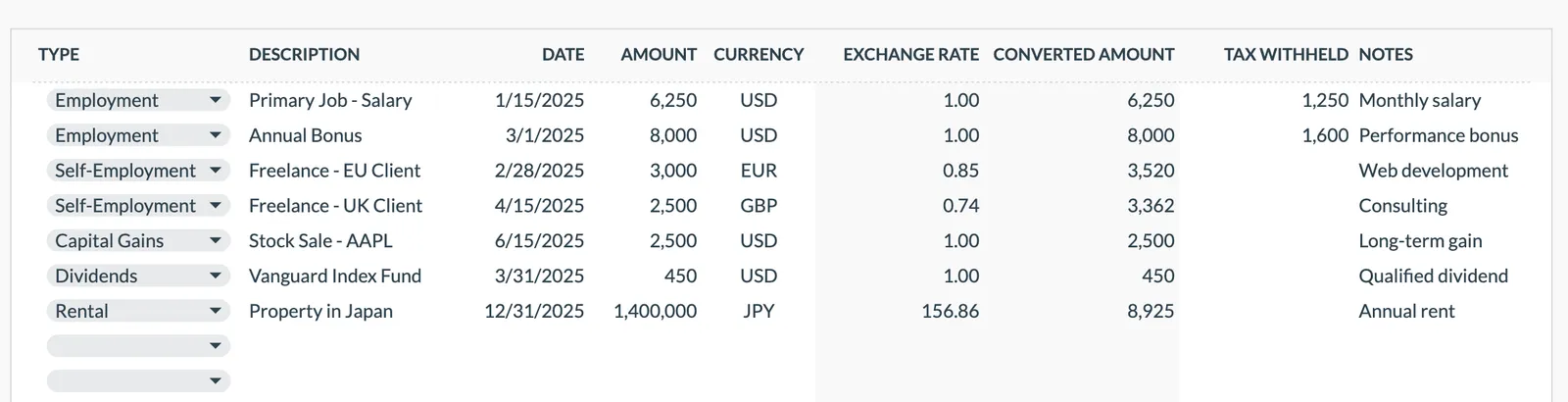
Browse through the template to see how it tracks income, deductions, credits, and estimated quarterly payments.
- Annual tax overview dashboard
- Income tracking by source
- Deductions and credits organizer
- Quarterly payment tracker
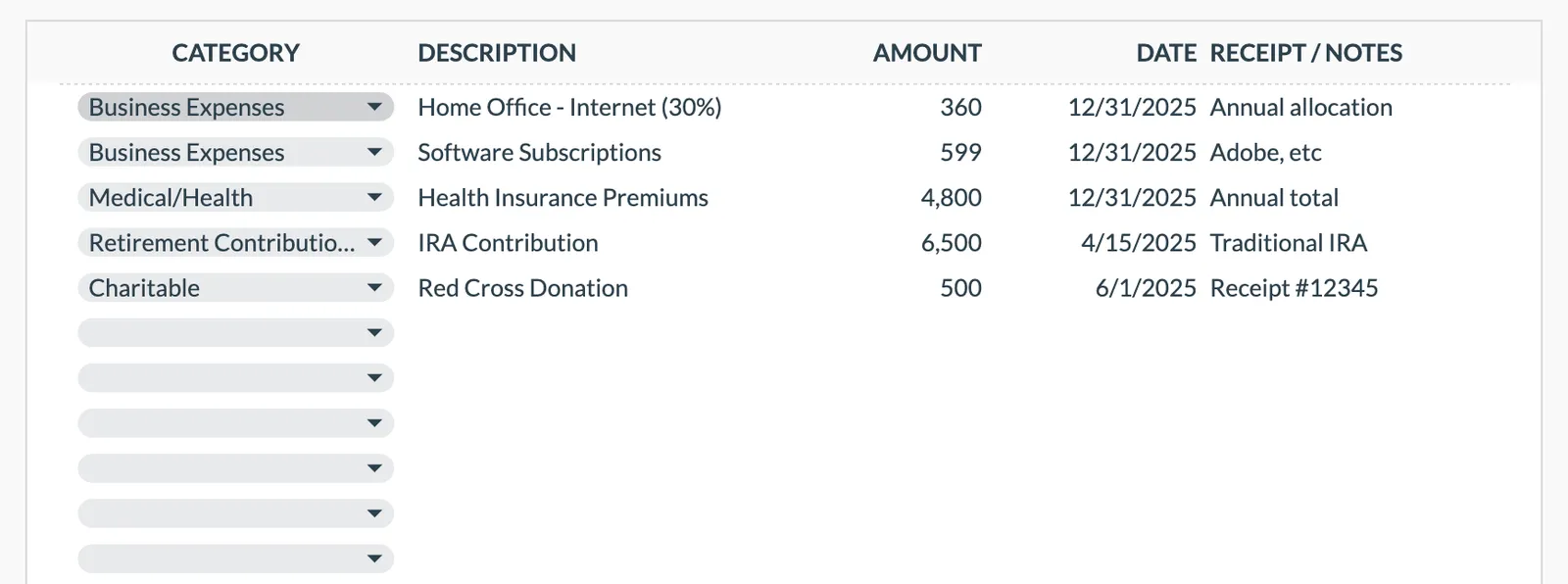
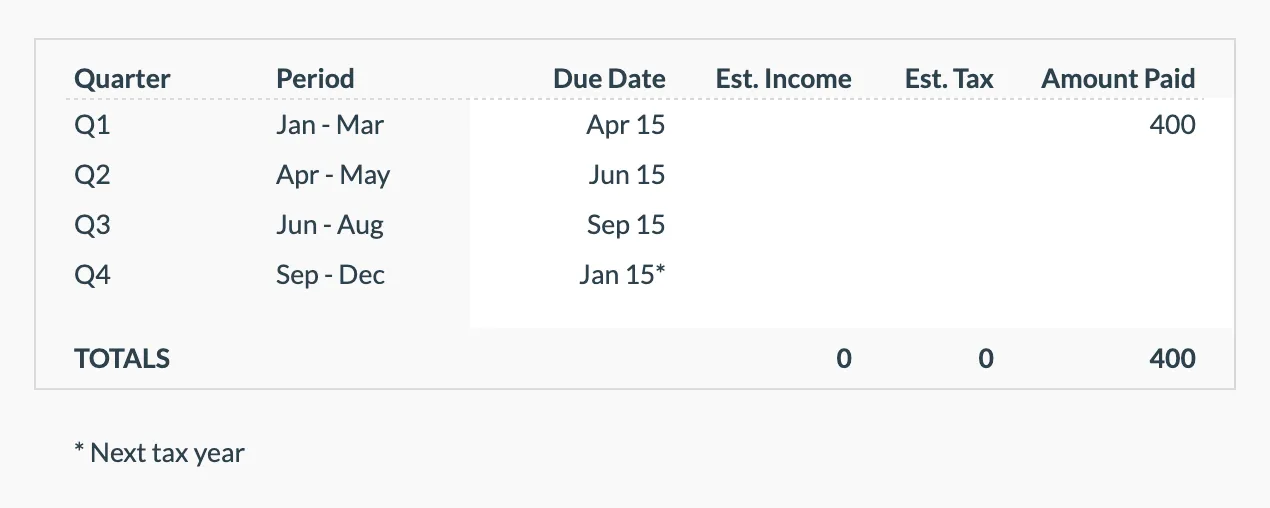
Annual tax overview with key figures
Detailed tax breakdown and projections
Track all income sources for tax purposes
Organize and track tax deductions
Plan and track quarterly estimated tax payments
Common Questions
Tax Planning in Georgia - FAQ
When did Georgia switch to a flat income tax?
Georgia moved from graduated brackets to a flat rate beginning in tax year 2024, starting at 5.39% and stepping down to 5.19% for 2025 and 4.99% for the 2026 tax year [2]. Previously, the state had multiple brackets, but the top rate kicked in at such a low threshold that most working adults were already paying near the top rate. The shift to a flat rate formalized what was already the practical experience for most taxpayers and simplified state tax calculations.
What is Georgia's standard deduction and how does it differ from federal?
Georgia has its own standard deduction of $24,000 for joint filers and $12,000 for single filers, separate from the federal standard deduction. Georgia generally requires the same type of deduction claimed on the federal return, so itemizing federally means itemizing for Georgia too. Georgia's deduction amounts are notably lower than the federal figures, so state taxable income is often higher than federal taxable income.
How does Georgia treat retirement income?
Georgia provides a retirement income exclusion of up to $35,000 per person at ages 62 to 64, applied to the combined total of pensions, annuities, interest, dividends, and other qualifying income. Residents 65 and older can exclude up to $65,000 each. Social Security benefits are exempt from Georgia tax on their own and do not count against the cap, so understanding how the remaining income sources aggregate is useful for projecting state liability in retirement.
Do Georgia property taxes vary enough to affect federal SALT planning?
Georgia property taxes vary significantly by county. Metro Atlanta counties like Fulton, DeKalb, Cobb, and Gwinnett have different assessment ratios and millage rates. The homestead exemption reduces assessed value for primary residences. Combined with the flat state income tax, tracking the total of state income tax plus property tax against the federal SALT cap shows how much federal deduction benefit you actually receive.
Can I use this template now that Georgia has a flat rate?
The template covers federal tax planning in detail, which is the more complex side. Georgia's flat 4.99% rate for the 2026 tax year makes state calculations simple - multiply your Georgia taxable income by the rate. Use the notes and custom fields to track Georgia-specific items like the state standard deduction and the retirement income exclusion alongside your federal projections.
Can't find the answer you're looking for? Contact our team
Official Tax Resources
For current rates, forms, and filing deadlines specific to Georgia:
Sources
Organize your tax planning for Georgia
One-time purchase. No subscription. Your financial data stays in your Google Drive.
Tax rules, rates, and contribution limits change, and official publications can themselves lag behind the law in force. We review these figures on a best-effort basis against sources we consider authoritative, but we cannot guarantee they are current, complete, or that better sources do not exist, and nothing here is tax, legal, or financial advice. For decisions, the relevant government authority is the reference. Last reviewed: August 2026.