United States
Retirement Planning Template for the United States
Lay out your 401(k), Roth IRA, Social Security estimates, HSA, and projected expenses side by side - in a Google Sheets template you own.
In Depth
The Moving Parts of Retirement in America
Retirement planning in the US involves more moving parts than in most countries, largely because the system relies heavily on individual savings rather than government provision. Social Security provides a foundation, averaging a little over $2,000 a month for retired workers in 2026 after the Social Security Administration applied a 2.8% cost-of-living adjustment, but that alone falls short of what most people spend in retirement. The gap between Social Security income and actual living expenses is what personal savings need to cover, and the size of that gap depends on individual lifestyle, location, and health.
Healthcare is the wildcard that makes US retirement planning distinctly challenging. Medicare eligibility begins at 65, but it doesn't cover everything - Part B premiums, supplemental insurance, dental, vision, and long-term care all add costs. For those retiring before 65, the gap years require marketplace insurance or COBRA coverage, which in 2026 can run from several hundred dollars to more than $1,500 per month depending on age and location, with costs higher after the enhanced ACA premium tax credits expired at the end of 2025. This single expense category can be the difference between retiring comfortably at 60 versus working until 65.
The order in which you draw from different accounts in retirement, known as a withdrawal strategy, can meaningfully affect how long your money lasts. Drawing from taxable accounts first while letting Roth accounts grow tax-free, strategically converting Traditional IRA funds to Roth during lower-income years, and managing income to stay below Medicare premium surcharge thresholds are all planning decisions that benefit from seeing the full picture. A retirement planning template that shows all accounts, projected Social Security, and estimated expenses in one view makes these tradeoffs visible.
United States
Retirement Planning in the United States: Key Factors
US retirement planning involves multiple account types, Social Security considerations, and healthcare costs that are unique to the American system.
401(k) and IRA accounts form the foundation
Most Americans build retirement savings through employer 401(k) plans and individual IRAs. For 2026 the IRS set the 401(k) deferral limit at $24,500 ($32,500 with the age 50 catch-up, $35,750 at ages 60 to 63) and the IRA limit at $7,500 ($8,600 if 50 or older). Employer matching in a 401(k) is essentially additional compensation - worth understanding your plan's vesting schedule.
Social Security provides a baseline but may not be enough
The Social Security Administration applied a 2.8% cost-of-living adjustment for 2026, and the average retired worker benefit now runs a little over $2,000 a month. Benefits depend on your 35 highest-earning years and claiming age. Claiming at 62 reduces benefits permanently, while waiting until 70 increases them by about 8% per year after full retirement age. Many people find Social Security covers only a portion of retirement expenses.
Healthcare costs are the wildcard
Medicare begins at 65, but premiums, supplemental coverage, dental, vision, and long-term care still add up. For those retiring before 65, marketplace health insurance fills the gap, and unsubsidized premiums often run from several hundred dollars to well over $1,500 a month depending on age and location. The enhanced ACA premium tax credits expired at the end of 2025, and KFF reports marketplace enrollment fell in 2026 as costs rose. Healthcare is often the largest variable in US retirement planning.
Tax diversification across account types matters
Having money in pre-tax (Traditional 401(k)/IRA), tax-free (Roth), and taxable accounts gives flexibility in retirement to manage tax brackets. The order and timing of withdrawals from different account types can meaningfully affect how long savings last.
Get the Template
Getting Started
Tailoring the Retirement Planner to US Accounts
Enter current retirement account balances
List every retirement-related account: 401(k), 403(b), Traditional IRA, Roth IRA, HSA (often used as a stealth retirement account), pension, and taxable brokerage. Current balances provide the starting point for projections.
Enter yearly contributions per account
Enter how much you contribute annually to each account, including any employer match. Note whether contributions are pre-tax or Roth. This drives the growth projections in the template.
Estimate Social Security benefits
The SSA.gov website provides personalized benefit estimates. Enter your projected monthly benefit and planned claiming age. Even rough estimates help fill in the retirement income picture.
Project retirement expenses
Estimate monthly retirement spending - housing, healthcare, food, travel, insurance, and taxes. A common starting point is 70-80% of pre-retirement spending, but individual needs vary widely. Healthcare costs deserve a separate line item.
Run different scenarios
Duplicate the template to test different retirement ages, spending levels, and market return assumptions. Seeing how changes affect the outcome helps make more informed decisions about savings rates and retirement timing.
See It In Action
What the template looks like
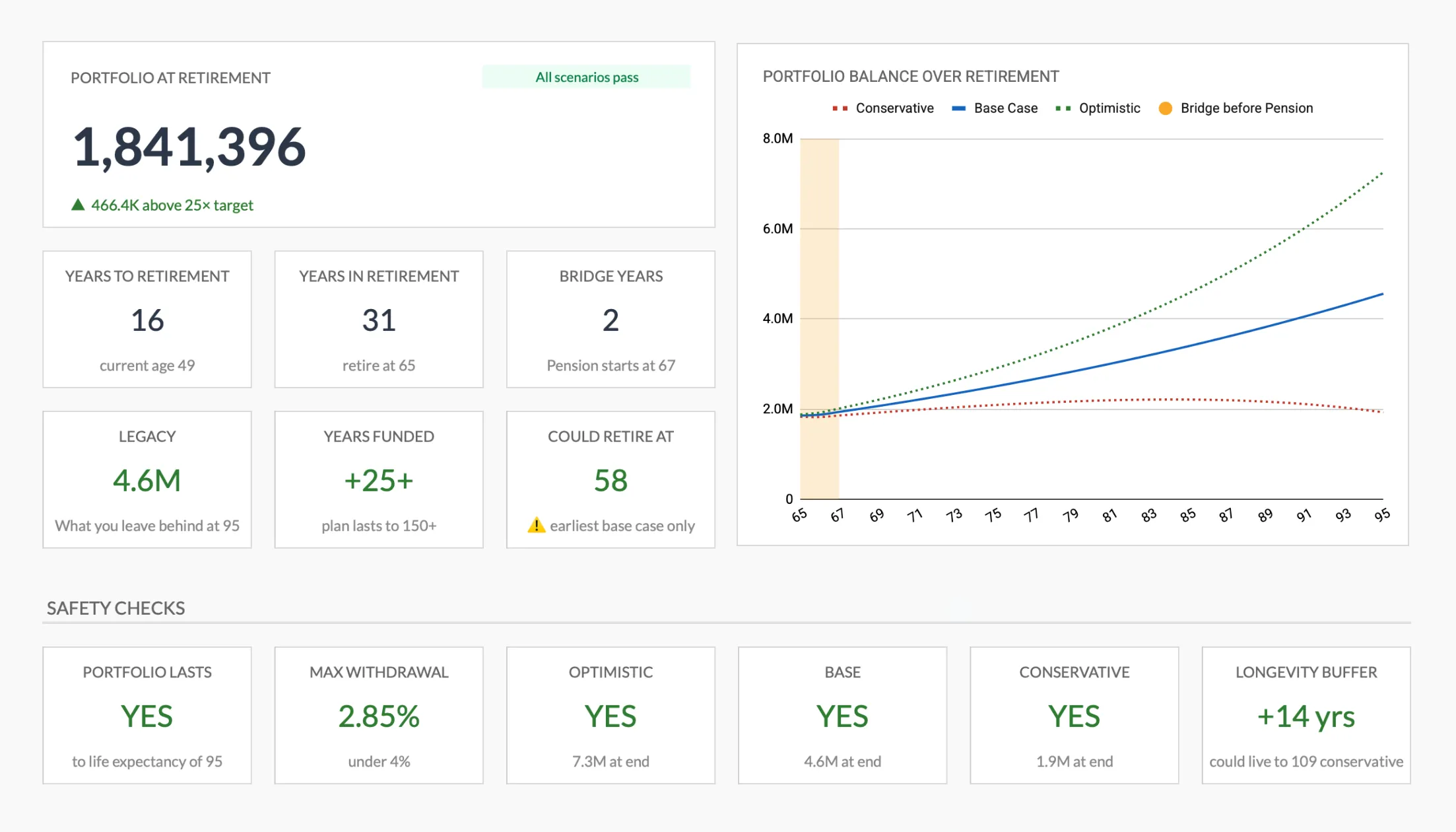
Browse through the template to see the dashboard, the entry sheets, and the summaries it produces, all adaptable to your local financial setup.
- Built-in currency selector
- Calculations update automatically
- Visual summaries of your numbers
- No setup required
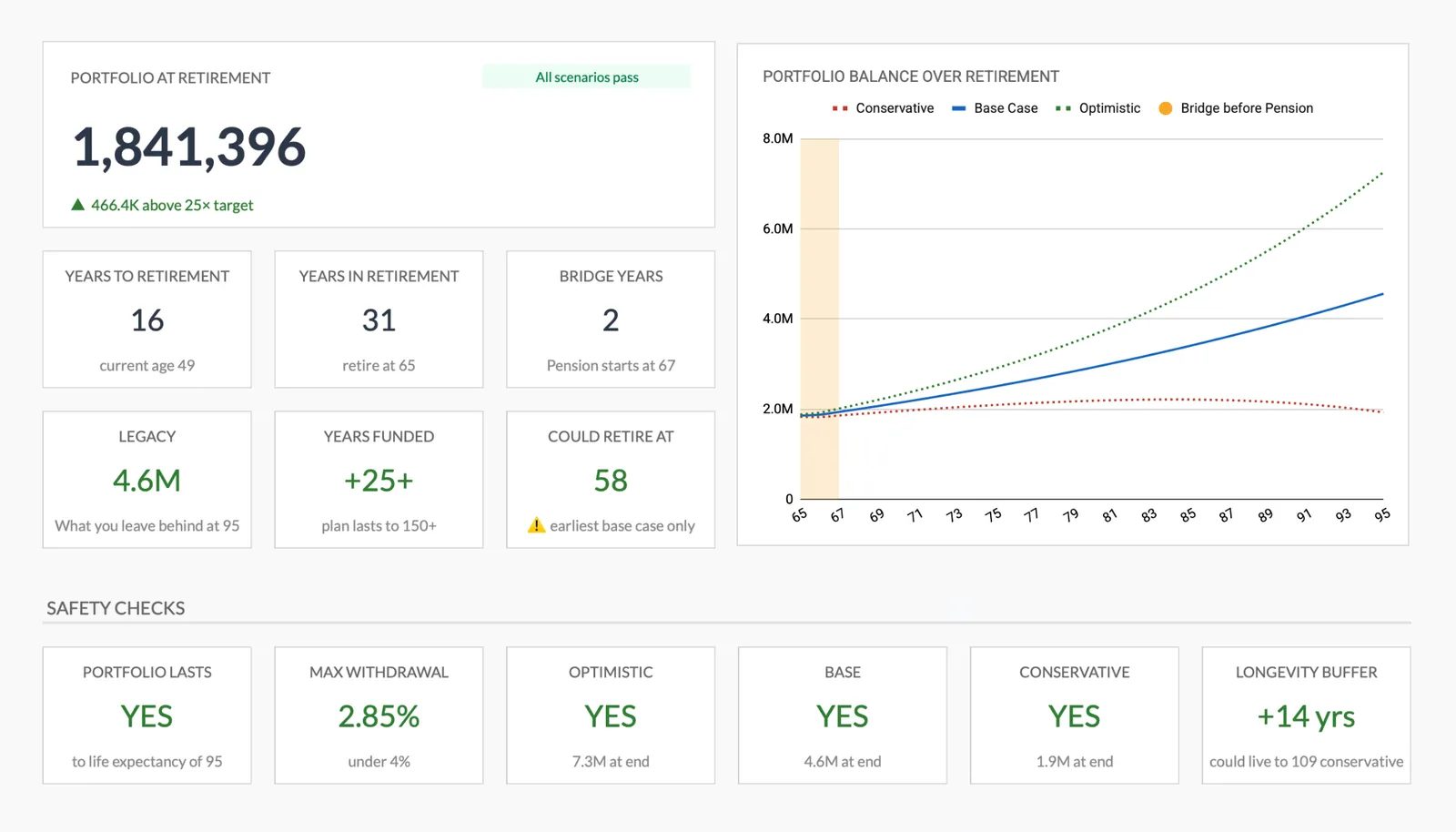
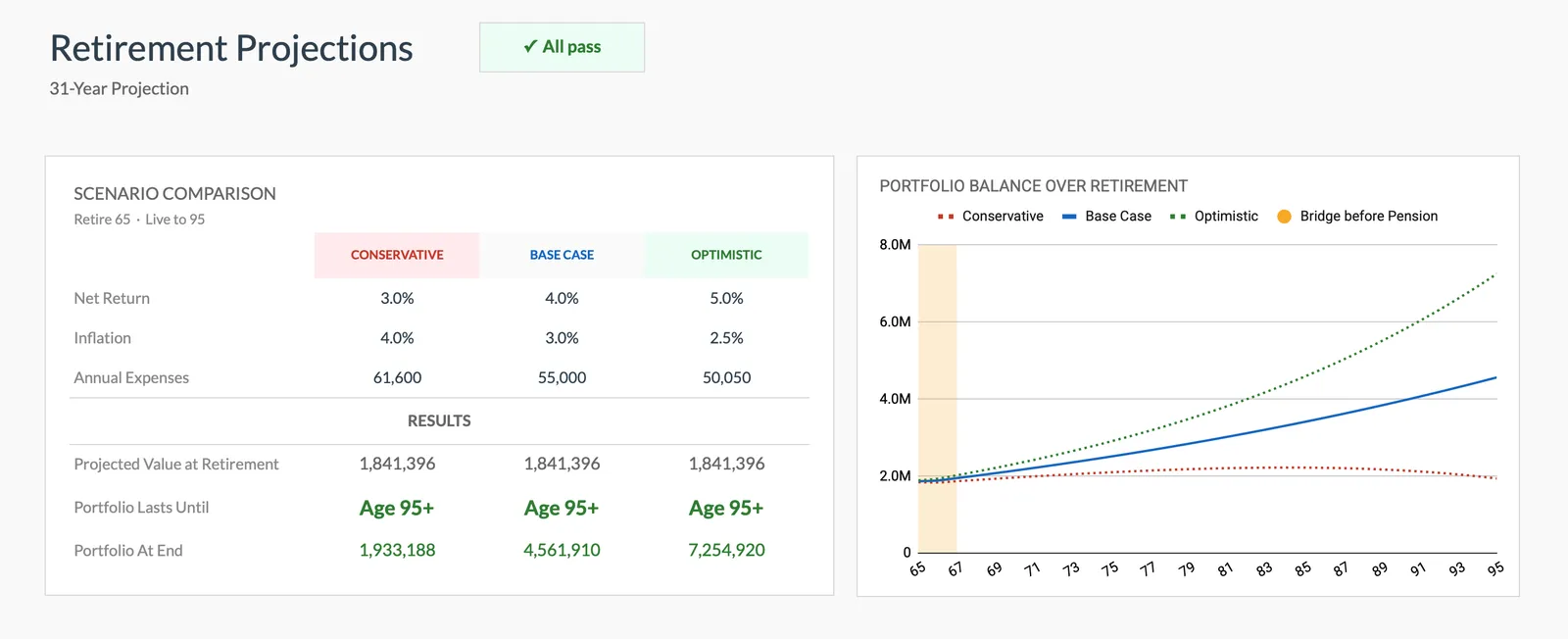
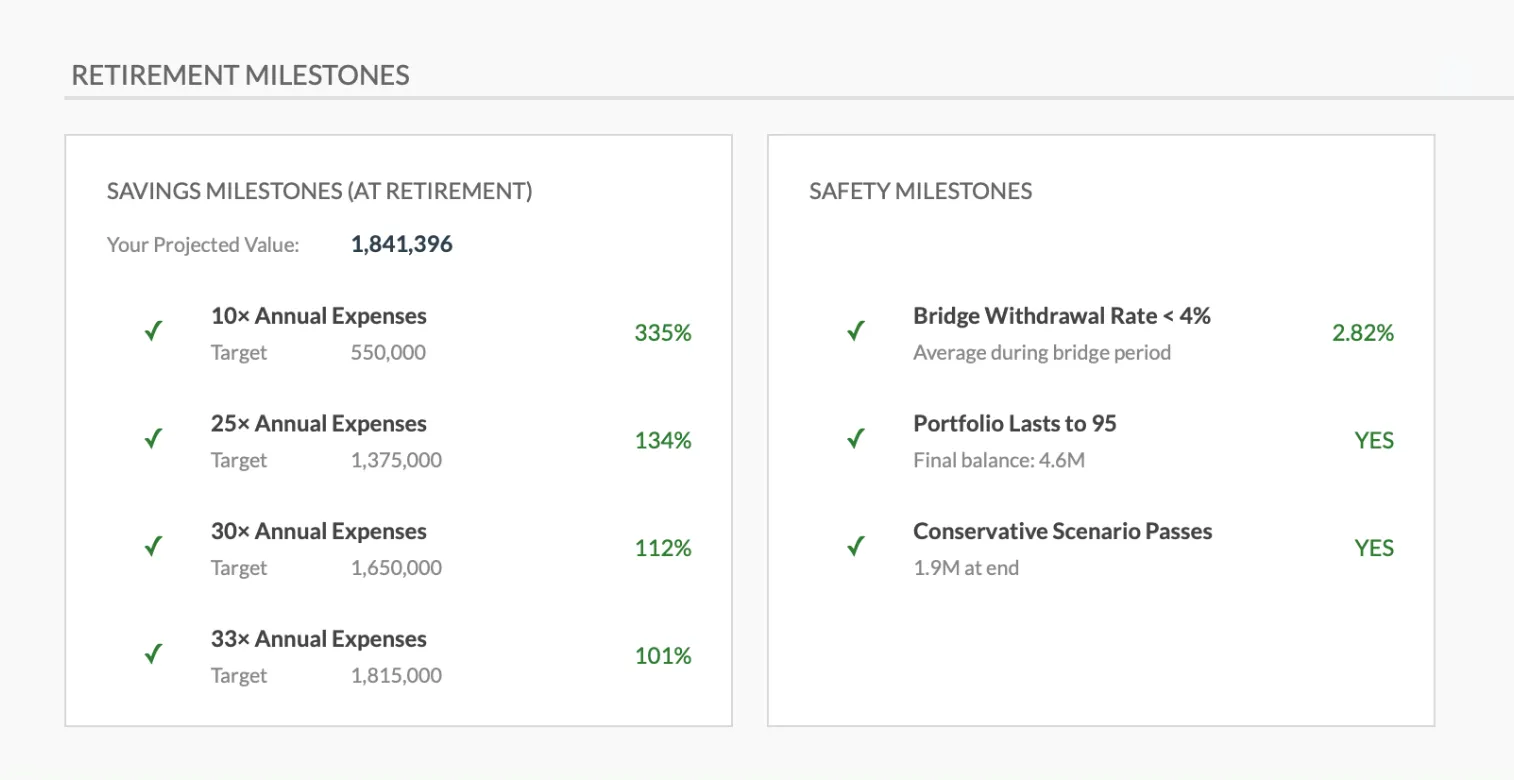
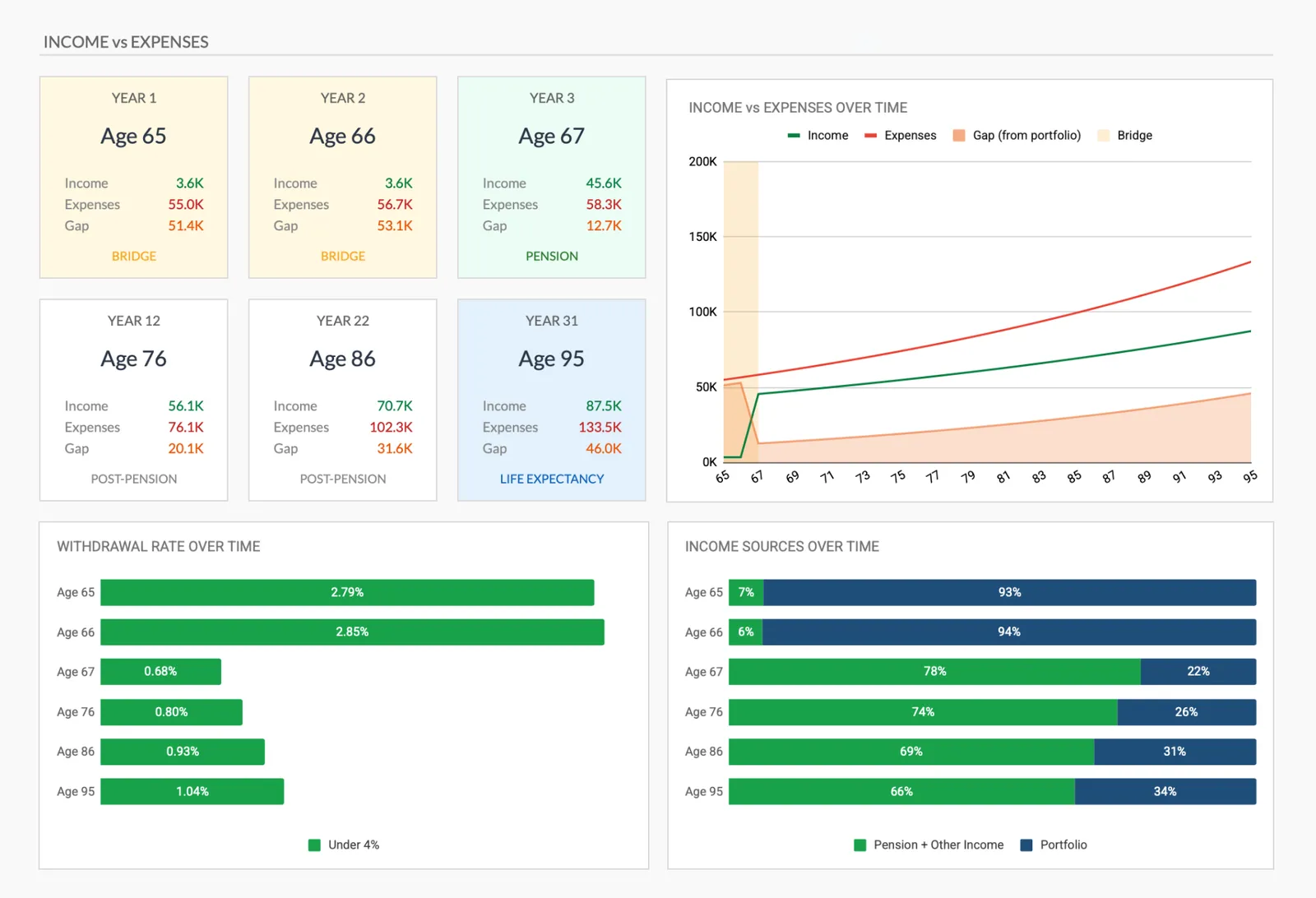
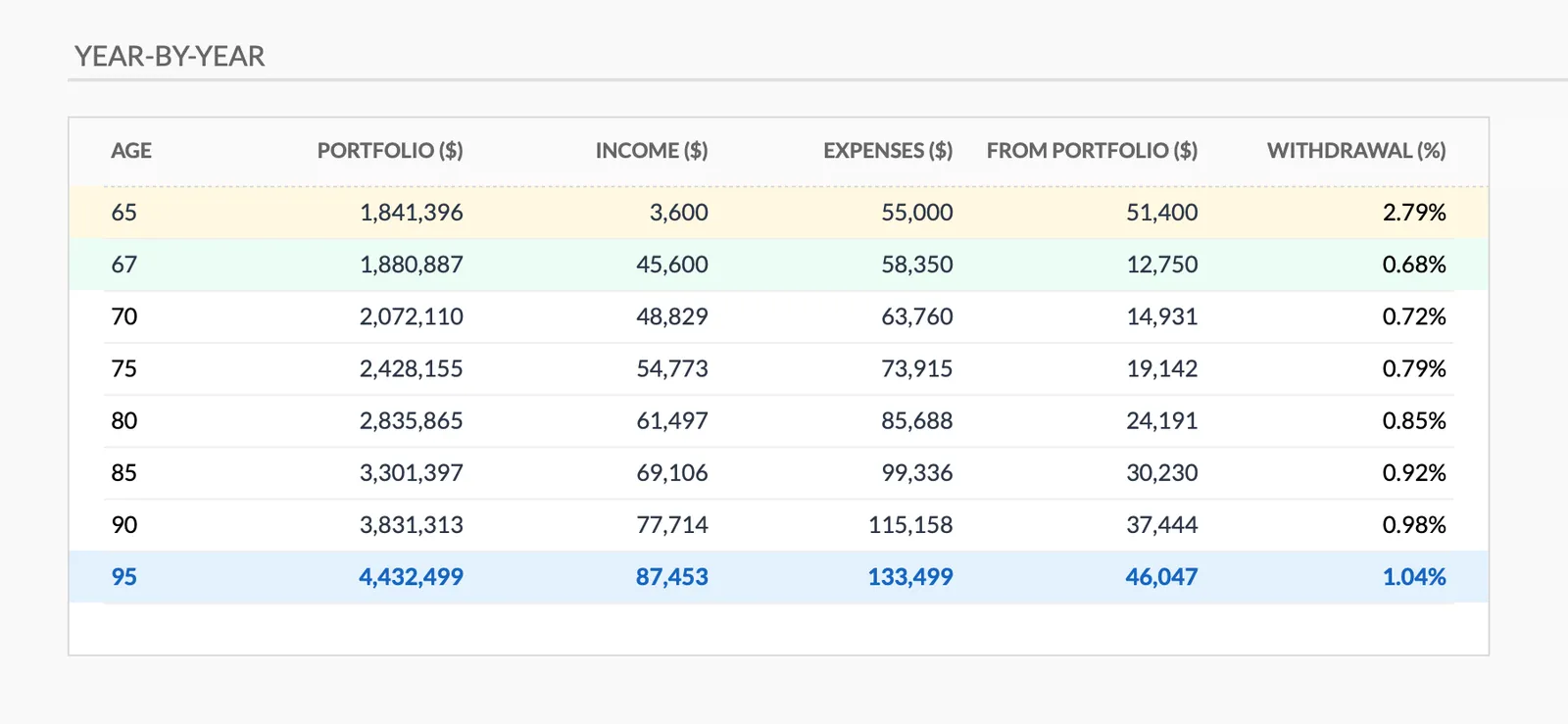
Complete retirement overview with projections
Project your retirement savings growth
Track progress toward retirement goals
Plan your retirement income against expenses
Detailed year-by-year retirement projection
Common Questions
Retirement Planning Template for the United States - FAQ
When can I access my retirement accounts without penalty?
Generally, 59.5 is the age for penalty-free withdrawals from 401(k) and Traditional IRA accounts. Roth IRA contributions (not earnings) can be withdrawn anytime. The Rule of 55 allows penalty-free 401(k) access if you leave your job at 55+. These rules have nuances - worth researching your specific situation.
How much do I need to retire in the US?
There's no universal number. The common "25x annual expenses" rule (based on the 4% withdrawal rate) is one framework. Someone spending $60,000/year might target $1.5 million. But this varies based on Social Security benefits, healthcare costs, location, and lifestyle. The template helps you work through your specific numbers.
Should I prioritize 401(k) or Roth IRA?
This depends on your current vs. expected future tax rate - a personal decision. Many people contribute enough to the 401(k) to capture the full employer match first, then consider Roth IRA contributions. The free 401(k) vs Roth 401(k) calculator on this site can help compare scenarios.
How do I account for inflation?
When projecting future expenses, assume prices will rise over time. A common approach is using inflation-adjusted (real) returns on investments rather than nominal returns. For example, if you assume 7% nominal returns and 3% inflation, use 4% real returns in your projections.
Can I plan for early retirement?
Yes. The template works for any retirement age. Early retirement planning requires extra attention to the gap before Medicare (healthcare costs), accessing retirement funds before 59.5 (Roth ladder, Rule of 55, SEPP/72t), and longer planning horizons that need more conservative assumptions.
Can't find the answer you're looking for? Contact our team
Explore More
Free Tools for the United States
Ready to get started?
Download instantly and start managing your finances, or contact us to design a custom template package for your needs.
Tax rules, rates, and contribution limits change, and official publications can themselves lag behind the law in force. We review these figures on a best-effort basis against sources we consider authoritative, but we cannot guarantee they are current, complete, or that better sources do not exist, and nothing here is tax, legal, or financial advice. For decisions, the relevant government authority is the reference. Last reviewed: August 2026.