United States
Net Worth Tracker for the United States
See where you actually stand - add up your 401(k), home equity, student loans, and brokerage accounts to get one clear net worth number that updates over time.
In Depth
What the Numbers Really Look Like Across American Age Groups
The Federal Reserve Survey of Consumer Finances gives one of the clearest pictures of American wealth, and the 2022 survey is the most recent release. Median net worth was $39,040 for households under 35 and $364,270 for those aged 55 to 64, with households aged 65 to 74 highest at $410,000. These numbers include home equity, which is the single largest asset for most American households. Stripping out the home often reveals a much smaller pool of liquid, investable wealth.
Retirement accounts represent a growing share of net worth for working-age Americans, but the distribution is uneven. In the 2022 Survey of Consumer Finances, 54.3% of US families held any retirement account, which leaves close to half holding none. Among families aged 55 to 64 that did hold one, the median balance across all retirement accounts was $185,000, and for ages 65 to 74 the median was $200,000. Including all retirement accounts alongside taxable investments, home equity, and debts gives a comprehensive view - and for many people, seeing it all in one place for the first time is eye-opening.
Student loan debt reshapes the net worth picture for younger Americans in a way that previous generations didn't experience at the same scale. With total US student debt at about $1.86 trillion in June 2026 in the Federal Reserve G.19 consumer credit release, many graduates start their financial lives in negative territory. Tracking net worth from that starting point, watching the number climb from negative toward zero and then into positive territory, provides a measure of progress that income alone does not capture.
United States
Net Worth in the United States: What to Track
Americans typically hold wealth across multiple account types and carry various forms of debt. A net worth tracker brings all of these into one view.
Retirement accounts are often the largest asset
For many Americans, 401(k) and IRA balances represent a significant portion of total net worth. Including these alongside taxable investments gives a more complete picture, though it's worth noting that pre-tax retirement account balances will be reduced by taxes upon withdrawal.
Home equity is a major but illiquid asset
For homeowners, the difference between your home's market value and your mortgage balance is a significant net worth component. Some people track this based on recent comparable sales or sites like Zillow, updating periodically rather than obsessing over monthly fluctuations.
Student loan debt is widespread
US student loan balances totalled about $1.86 trillion in June 2026 in the Federal Reserve G.19 consumer credit release. Including this liability in your net worth calculation gives an honest picture - even if the number starts negative. Tracking the balance declining over time can be motivating and helps measure real financial progress.
Net worth percentiles provide useful context
Median household net worth in the US varies widely by age group, from $39,040 for under-35s to $364,270 for 55-64 year olds in the 2022 Federal Reserve Survey of Consumer Finances, the most recent release. Knowing where you stand relative to peers can provide context, though comparing to your own past progress is often more useful.
Get the Template
Getting Started
Adapting the Net Worth Tracker for the US
List all assets with current balances
Enter checking accounts, savings, 401(k), IRA, Roth IRA, HSA, brokerage accounts, home value, vehicle value, and any other assets. Use current balances from your latest statements.
Add every debt and obligation
Include mortgage balance, student loans, auto loans, credit card balances, personal loans, and any other debts. Be thorough - the point is to capture everything for an accurate net worth calculation.
Set the display currency to USD
Choose USD from the currency menu in the header. Once selected, all values display consistently in US dollars.
Refresh balances on a regular schedule
Net worth tracking is about trends, not daily fluctuations. Monthly updates work well for most people. Log new balances and the template calculates your net worth automatically, showing the change over time.
Track the trend, not the number
A single net worth snapshot is less useful than seeing the trajectory. Whether starting from a negative number or already positive, the direction and rate of change tell the real story of financial progress.
See It In Action
What the template looks like
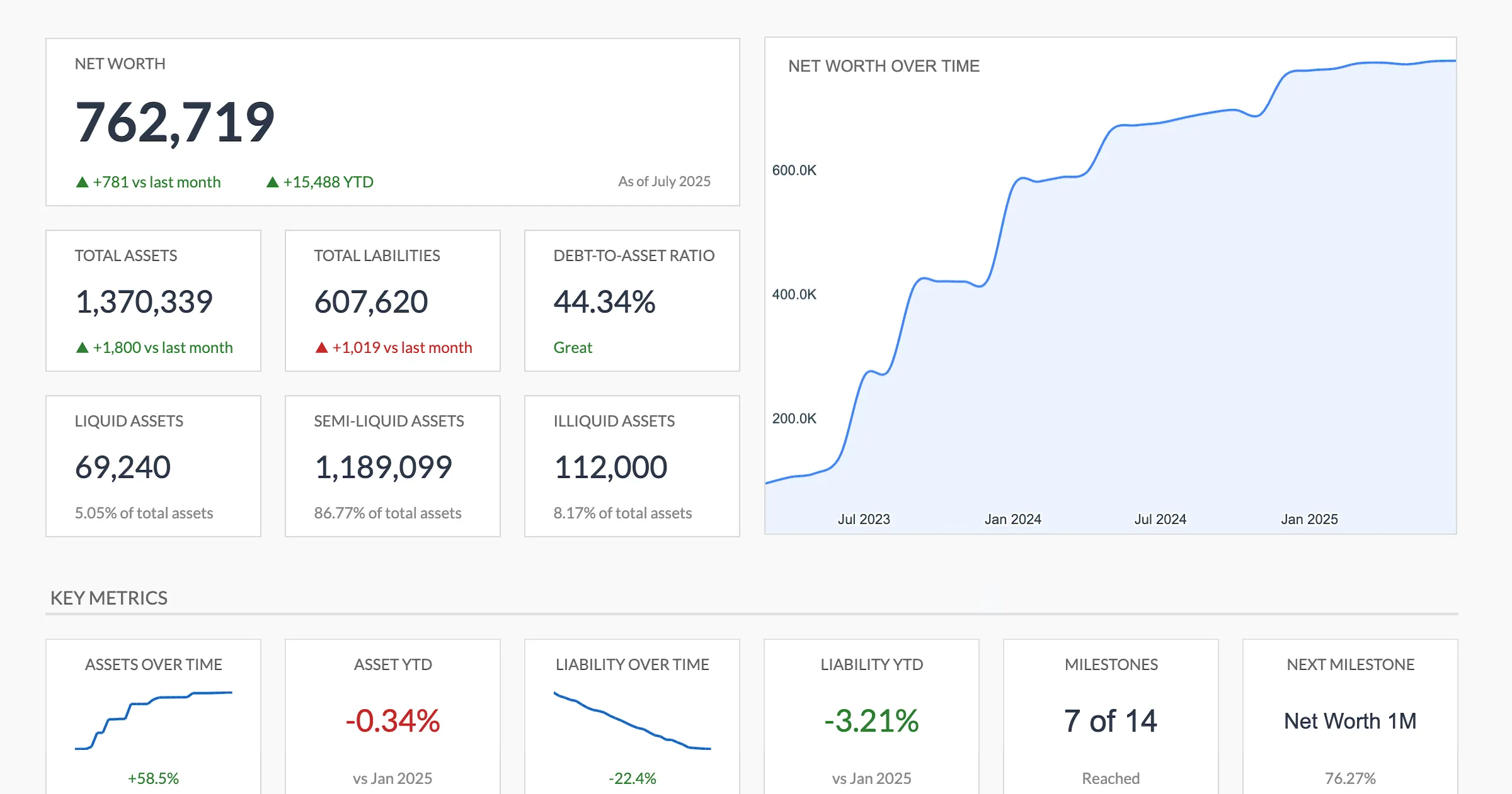
Browse through the template to see the dashboard, the entry sheets, and the summaries it produces, all adaptable to your local financial setup.
- Built-in currency selector
- Calculations update automatically
- Visual summaries of your numbers
- No setup required
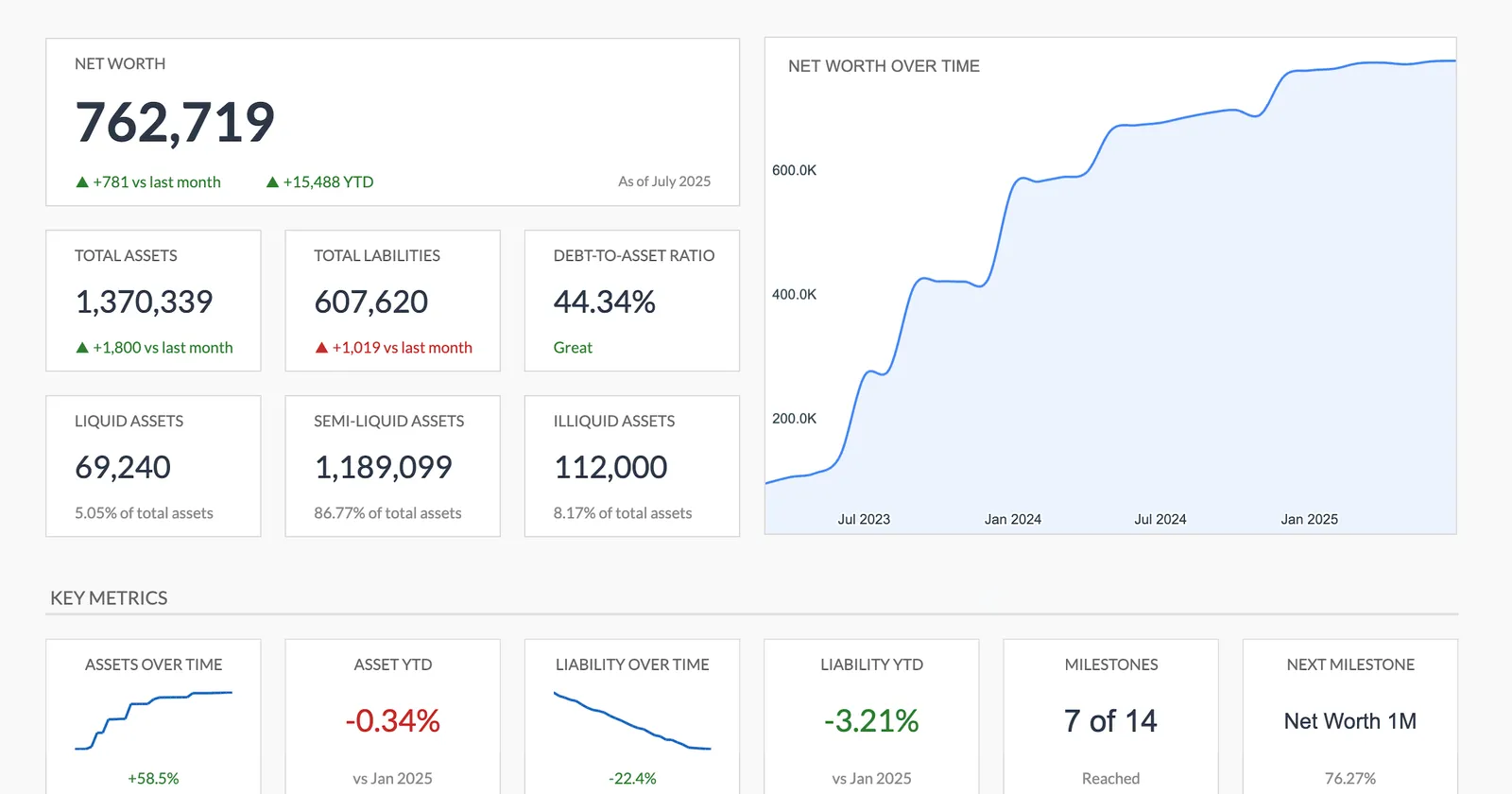
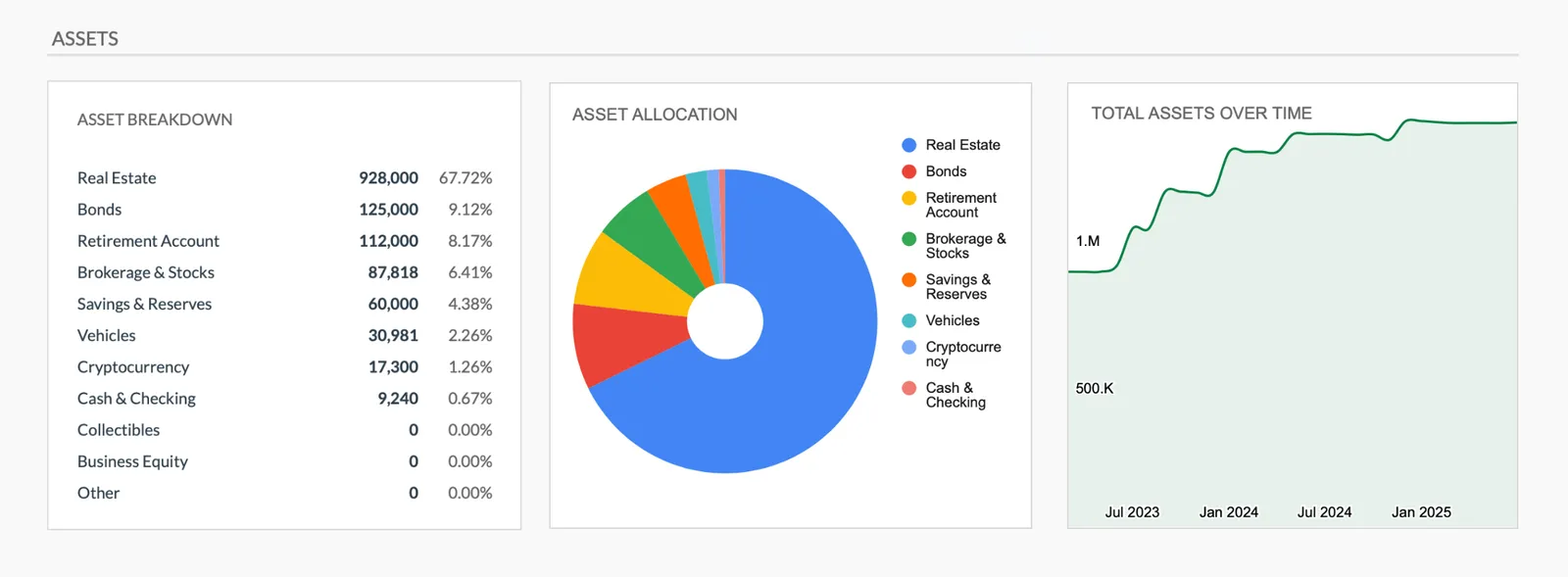
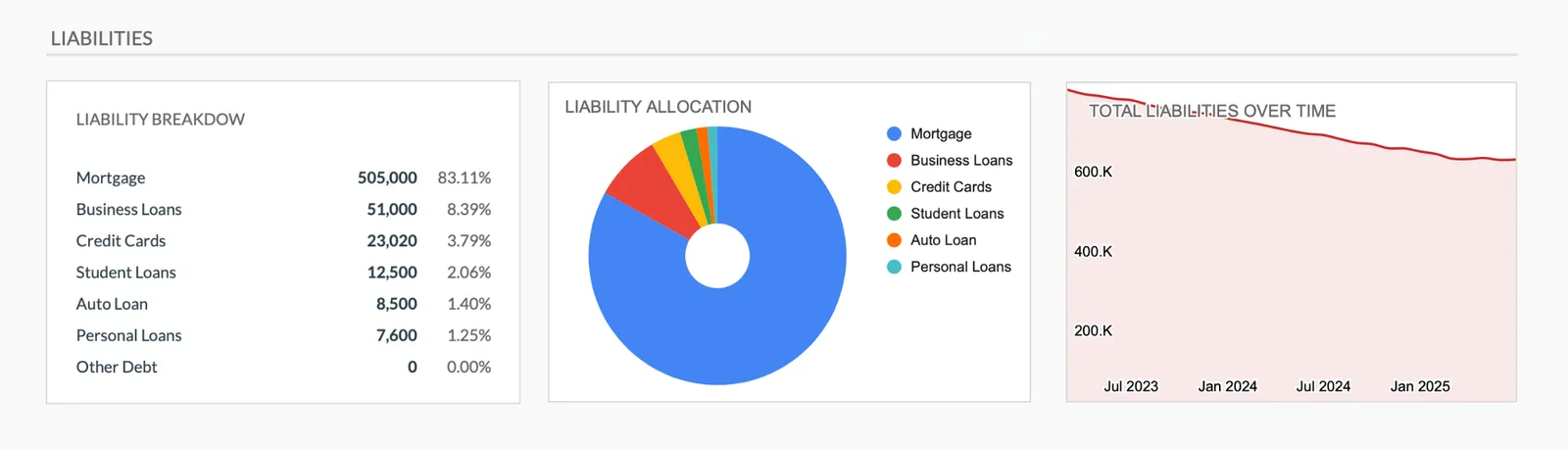

Track your net worth over time with charts
Breakdown of all your assets
Track all debts and liabilities
Key financial health indicators
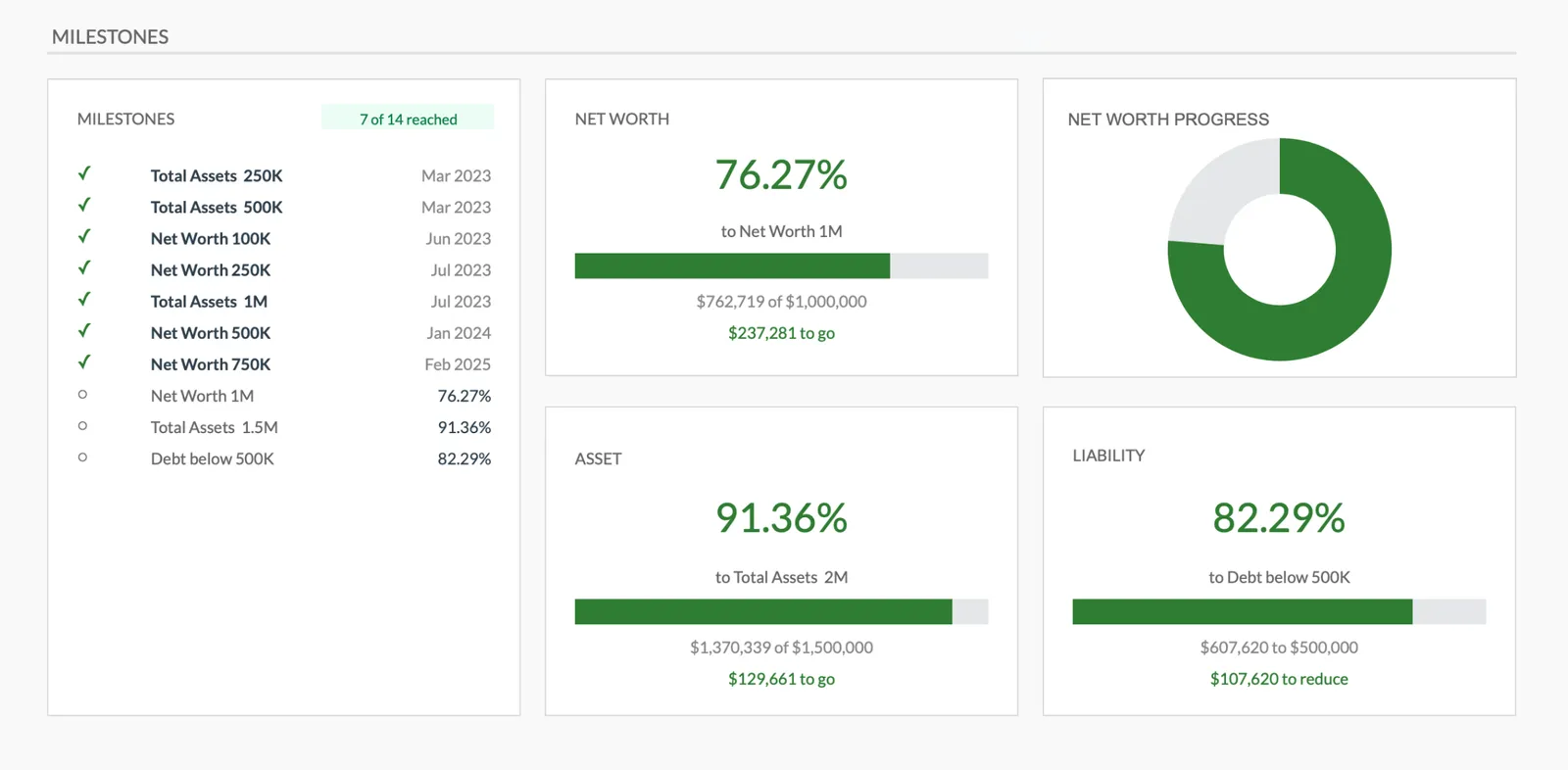
Set and celebrate net worth milestones
Common Questions
Net Worth Tracker for the United States - FAQ
Should I include my home in net worth?
Most financial professionals include home equity (market value minus mortgage balance) in net worth calculations. Some people also track "liquid net worth" separately, excluding the home and other illiquid assets, for a view of what is actually accessible.
How do I value pre-tax retirement accounts?
Enter the current balance as shown by your 401(k) or Traditional IRA provider. Some people mentally note that these balances will be reduced by income taxes upon withdrawal, but for tracking purposes, the full balance is standard.
Should I include my car?
It depends on your preference. If you include it as an asset, use a realistic resale value (Kelley Blue Book or similar) rather than what you paid. Some people skip vehicles since they depreciate and aren't financial assets in the traditional sense.
What if my net worth is negative?
This is common, especially for younger Americans with student loans. Starting from a negative number and tracking progress upward is exactly what a net worth tracker is for. The trend matters more than the starting point.
How often should I update?
Monthly is the most common cadence. Quarterly works too. More frequent than monthly tends to cause unnecessary stress over market fluctuations that don't reflect real financial changes.
Can't find the answer you're looking for? Contact our team
Explore More
Free Tools for the United States
Ready to get started?
Download instantly and start managing your finances, or contact us to design a custom template package for your needs.
Tax rules, rates, and contribution limits change, and official publications can themselves lag behind the law in force. We review these figures on a best-effort basis against sources we consider authoritative, but we cannot guarantee they are current, complete, or that better sources do not exist, and nothing here is tax, legal, or financial advice. For decisions, the relevant government authority is the reference. Last reviewed: August 2026.